Your Clients Are Already Shopping Online. Are They Finding Your Pet Business?

TL;DR 43% of UK cat owners and 39% of dog owners now buy pet products online first. Regular online shoppers in Europe grew from 48% to 52% in two years, and Instagram converts 4 in 10 visitors into buyers. Your clients have already moved online - they research groomers, trainers, and pet care services the same way they shop for everything else. If your business isn't showing up in those searches, a competitor who is will get the booking. This article breaks down what the data means for your specific type of pet business and gives you five practical steps to fix your visibility this week - including how AI tools can make it manageable without taking over your life.
By Kirsty Skeates, Founder of PetBizAI | 10+ years in the pet industry
Picture this: it's 9pm. A dog owner has just decided their Labrador needs a professional groomer. They don't ask a friend - they open Google. They type "dog groomer near me." They scroll. They click the first business with photos, reviews, and a clear website. They book.
Your business might be better. Your prices might be fairer. But if you weren't in those results, you weren't in the running.
This happens dozens of times a day in your area. And the latest European e-commerce data makes clear that this isn't a trend to prepare for - it's the reality your clients are already living.
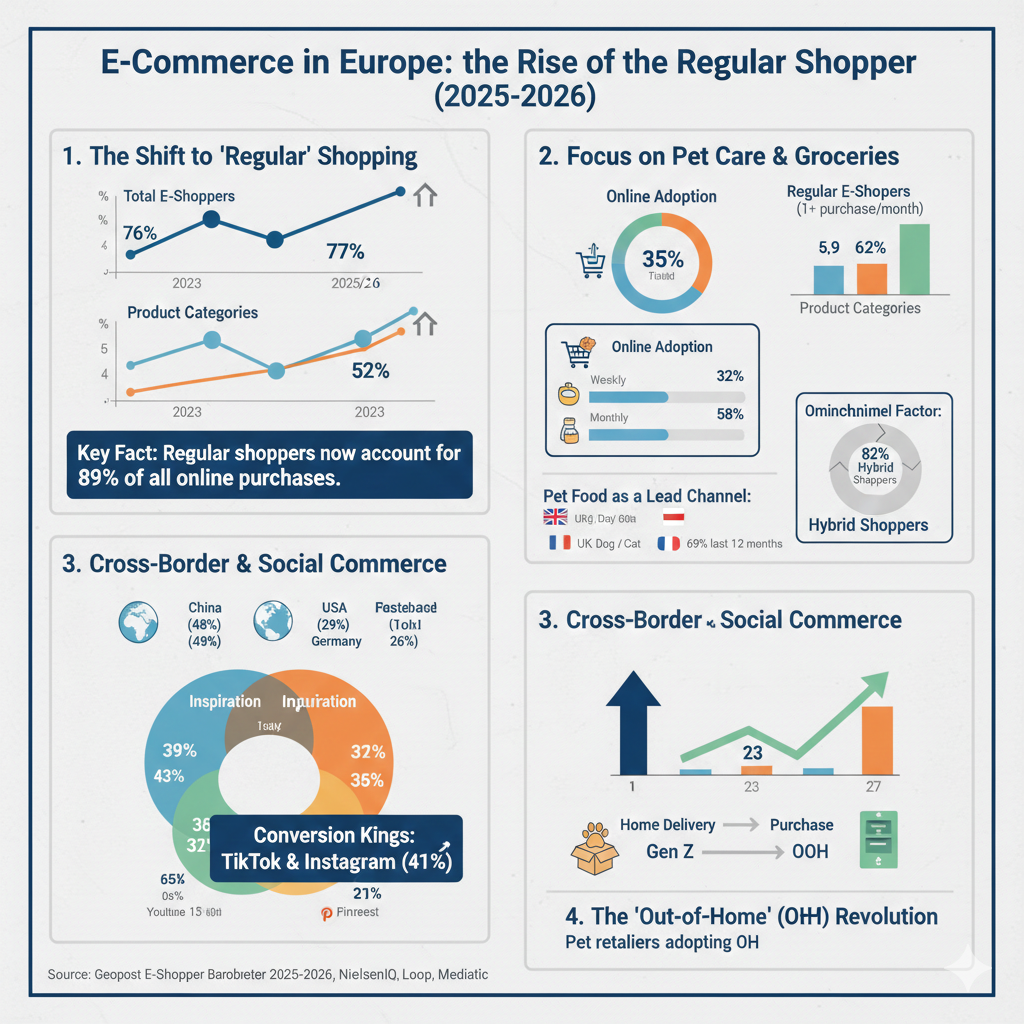
Here's the short version: 77% of Europeans now shop online regularly, 43% of UK cat owners say the internet is their primary channel for buying pet products, and social media platforms like Instagram now convert 4 in 10 visitors into buyers or bookings. Your clients have moved online. The question is whether they can find you when they get there.
This article breaks down what that data actually means for a grooming salon, training business, physio practice, or dog walking service - and what you can realistically do about it, with or without a big marketing budget.
Why Does It Matter That European E-Commerce Has "Matured"?
When the industry press reports that European e-commerce has "matured," it sounds like background noise. But for pet businesses, it's the most important sentence in the room.
Maturity means your clients aren't dipping a toe in anymore - they're fully at home online. The Geopost E-Shopper Barometer (2025) found that regular online shoppers - those buying at least once a month - grew from 48% to 52% in just two years. The average European shopper now buys across 6.2 different product categories online, up from 5.9 in 2023.
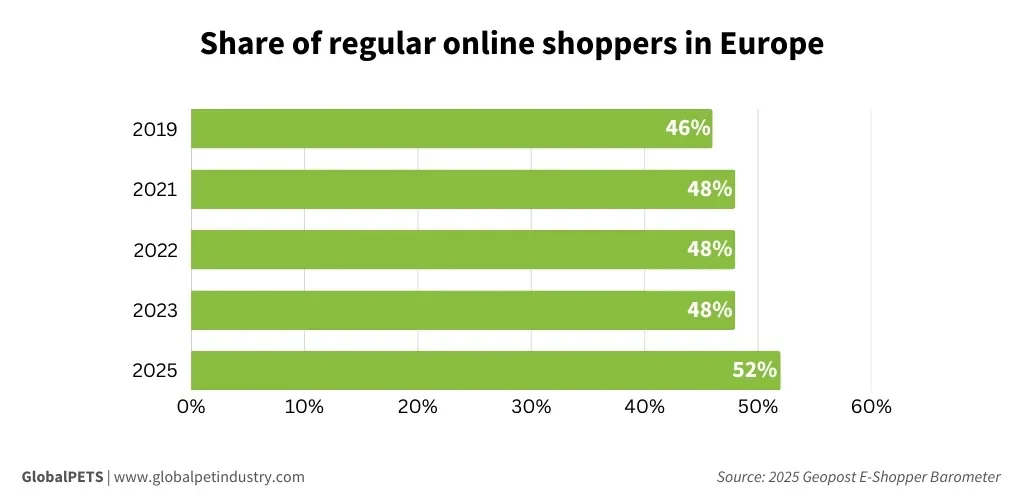
What this tells us isn't just that more people are buying things online. It's that online is now where the decision gets made - even for services they'll receive in person.
Think about how a new client found you in 2015. Word of mouth. A leaflet. A local Facebook group. Now think about how your most recent new clients found you. Chances are, at least some of them found your website, your Instagram, or your Google listing first - before they ever spoke to you. That shift has already happened. The data just confirms it.
For service-based pet businesses, this matters because your clients are researching you online the same way they research everything else. A dog owner looking for a hydrotherapist doesn't call ten clinics - they Google, read content, check reviews, and form an opinion before they pick up the phone. If your business doesn't appear in that research phase, you're out of the race before it starts.
What Do UK Pet Owners Actually Do Online Before They Book?
Let's get specific, because the generic "people are online" message doesn't help you much.
A 2025 Loop survey of 3,081 UK pet owners found that the internet is the top purchasing channel for pet food among dog owners (39%) and cat owners (43%). That's remarkable - nearly half of cat owners are buying pet food primarily online, and this behaviour shapes how they find everything else for their pets.
Here's what I consistently see with the pet business owners I work with: the same client who orders their dog's food on Amazon at midnight is the same one searching for a local groomer, trainer, or physio. The research habit doesn't switch off. It follows them everywhere.
What this typically looks like in practice:
A dog owner searches "how often should I groom a Cockapoo" - finds a helpful article on your blog - clicks around your site - checks your Instagram - sees your Google reviews - books an appointment. That's a customer journey that started with a question, not a service search. If you're answering questions in your content, you're in the running from step one.
A cat owner searches "do cats need hydrotherapy after surgery" - finds a clinic that has written something clear and helpful on that exact topic - trusts them enough to enquire. If you're a feline physiotherapist and you haven't written anything about post-surgical care, you're invisible to that person at the moment they're most ready to book.
NielsenIQ data from September 2025 backs this up: online channels are now driving double-digit growth in pet care, with some product categories - like bedding accessories and repellents - growing online while declining in stores. Pet owners are comfortable buying and researching digitally. That comfort extends naturally to services.
The Omnichannel Reality: Your Clients Move Between Online and In-Person
Here's a finding that surprised even me: NielsenIQ's research found that 82% of pet care spending now comes from consumers who buy both in-store and online.
This isn't a world of "digital pet owners vs. traditional pet owners." It's one world where the same person buys dog food online on Tuesday, visits a groomer on Friday, and checks Instagram on Saturday for tips on their new kitten. They're omnichannel by default. They don't think about it. It's just how they live.
What this means for your business is that you don't need to choose between your local community presence and an online presence - you need both to work together. The groomer with a loyal local clientele and a well-maintained Instagram account and Google profile is going to consistently outperform the one who relies on word of mouth alone.
The challenge is that most pet business owners are running their business solo or in a very small team. Maintaining a consistent presence across a website, Google, Instagram, Facebook, and email feels impossible on top of actually doing the job. That's precisely where AI tools earn their place - not by replacing your voice and expertise, but by reducing the time it takes to show up consistently.
A dog trainer I work with was spending around three hours a week trying to put content together. With a simple AI-assisted system, that dropped to 45 minutes - and the content improved because she wasn't rushing or stretching herself thin. Done is better than perfect, but consistently done beats both.
How Social Media Has Changed from "Brand Awareness" to "Booking Engine"
Here's a number worth sitting with: Instagram and TikTok have achieved a 41% conversion rate - meaning 4 in 10 people who click from those platforms to a linked website take action.
That's not brand awareness. That's a sales channel.
The Geopost data shows that Instagram is now the leading platform for purchase inspiration (36% of European online shoppers use it to discover what to buy or book), ahead of Facebook (32%) and YouTube (31%). TikTok is close behind at 25%.
For a grooming salon, this might look like a Reel showing the transformation of a matted rescue dog. For a dog trainer, it might be a carousel breaking down the three reasons recall fails in busy parks. For a physio or hydrotherapist, it might be a short video explaining what to expect in a first session. These aren't vanity posts - they're the moment a potential client goes from "I didn't know that existed" to "I need to book this."
A practical way to think about platform roles for your pet business:
Instagram and TikTok are where people discover you and decide if they trust you. Facebook is where they connect with you, join your community, or see your offers. Your website is where they book or enquire. Everything feeds into each other - but the journey often starts with content that answers a question or shows them something they didn't know they needed.
The good news is you don't need to be everywhere at once. Pick one platform where your ideal clients spend time. Show up there consistently. Answer their questions. Let them see who you are. The bookings follow.
This Is What AEO Means for Your Pet Business (and Why It Matters Right Now)
You've probably heard of SEO - making your website appear in Google results. AEO, or Answer Engine Optimisation, is the next layer: it's about making your content the source that AI tools like Google's AI Overviews, ChatGPT, and Perplexity cite when someone asks a question.
This blog post you're reading right now is an example of AEO in action. Notice how each section opens with a direct answer to the question in the heading. That structure is deliberate - it's designed so that when a pet owner (or a groomer researching their marketing options) asks an AI assistant "what does the European e-commerce shift mean for pet businesses?", there's a chance this content becomes part of the answer.
For your pet business, AEO looks like this:
A new dog owner asks ChatGPT: "How do I find a good puppy trainer in my area?" An AI tool, drawing on content it's indexed from trusted sources, might reference your blog post titled "What to look for in a puppy trainer: 5 questions to ask before you book." If your content is structured clearly, answers specific questions directly, and demonstrates genuine expertise, you're more likely to be cited - and more likely to be found.
The businesses that will dominate local pet services over the next three years will be the ones whose content answers the questions their clients are already asking. Not just on Google. On AI assistants. On social. Everywhere people search for answers.
AEO-ready content has three hallmarks: it answers a specific question directly at the start of each section, it uses clear headings that match how people actually phrase their queries, and it demonstrates real expertise - through credentials, experience, or specific practical knowledge. Generic content won't cut it. Content that sounds like it came from someone who genuinely knows what they're talking about will.
What Should You Actually Do This Week?
The data is pointing in one direction. Here's how to respond to it in a way that's realistic for a busy pet professional.
Step 1: Search for yourself as a new client would. Type the service you offer plus your town into Google. See what comes up. Does your business appear? Where? What does the listing look like compared to whoever ranks above you? This two-minute exercise usually surfaces the most urgent gaps.
Step 2: Update your Google Business Profile. This is the single highest-impact free action most pet businesses can take. Add recent photos of your space or your work. Make sure your services, hours, and contact details are accurate. Turn on messaging. And reach out to your five most recent happy clients and ask them directly for a Google review - most will do it if you make it easy for them.
Step 3: Write one piece of content that answers a real question. Not a sales post. A genuine answer to something clients ask you all the time. "How often should I groom a Springer Spaniel?" "What's the difference between a dog trainer and a behaviourist?" "What does a dog physiotherapy session actually involve?" Write 300 words answering it clearly. Put it on your website or blog. That's AEO in action.
Step 4: Choose one platform and show up consistently. You don't need six social media accounts. You need one that your ideal clients use, and you need to post something useful there every week. A photo from your working day. An answer to a question. A before-and-after. A 30-second video. Consistent and real beats polished and rare, every time.
Step 5: Use AI to handle the drafts - and add your voice. If the writing is what slows you down, AI can help. Tools like Claude can draft blog posts, social captions, and email newsletters in your voice - you describe what you want, it produces a working draft, you refine it with your experience and knowledge. PetBizAI's tools are built specifically for pet businesses, so the frameworks, terminology, and tone are already calibrated for groomers, trainers, and pet care professionals - not generic small businesses.
The system works best when you're providing the expertise and AI is handling the time-consuming production work. You know your clients. You know what questions they ask, what worries them, what makes them trust a business. AI just helps you get those answers out into the world faster.
Frequently Asked Questions
Do I really need a website if I already have a Facebook page? Yes - and this is important. Your Facebook page exists at Facebook's pleasure. They can change the algorithm, reduce your reach, or close your account. Your website is the one corner of the internet that you own and control. It's where Google sends search traffic, where clients book, and where your credibility is permanently established. A Facebook page is a channel to drive people to your website - not a replacement for one.
How long does it actually take to build a content system with AI? Most pet business owners I work with are creating a week's worth of content in 30-60 minutes once they have a simple system in place. The initial setup - working out your key topics, your voice, your templates - takes a few hours. After that, it becomes a rhythm. The goal is never to spend all day on content. It's to spend a defined, manageable amount of time doing it well.
My business is very local - does online really matter for me? More than you might think. Even for hyperlocal services like grooming, training, or hydrotherapy, the customer journey almost always starts online. Someone new to the area, someone whose usual groomer just retired, someone whose vet just recommended a physio - all of them will Google before they call. Appearing in those local searches is how you fill the diary without relying entirely on referrals.
What's the difference between SEO and AEO? SEO (Search Engine Optimisation) helps your content appear in traditional Google search results. AEO (Answer Engine Optimisation) helps your content get selected by AI tools - like Google's AI Overview, ChatGPT, or Perplexity - as the trusted answer to a specific question. Both matter. AEO is becoming increasingly important as more people use AI assistants to search rather than typing keywords into Google.
The Bottom Line
The European e-commerce data from 2025 isn't describing a future that's coming. It's confirming a present that's already here. Your clients are online, researching habitually, making decisions based on what they find - and the businesses that show up consistently with helpful, honest, expert content are the ones that win.
You don't need a marketing degree. You don't need a big budget. You need a clear strategy, a simple system, and the willingness to share your expertise in a format your clients can find.
That's what we help pet business owners build at PetBizAI. Not a complicated tech stack. Not a full-time content operation. A practical, sustainable way to be found by the people who are already looking for you.
If you're a groomer, trainer, physio, hydrotherapist, or any other pet professional who wants to understand how to do this properly, start with the free resources at PetBizAI.co.uk. There's no jargon, no overwhelm. Just practical help for real pet businesses.
👉 Explore PetBizAI tools and resources at petbizai.co.uk

Author bio: Kirsty Skeates is the founder of PetBizAI and has spent over 10 years working in and around the pet industry. She works with groomers, trainers, physiotherapists, hydrotherapists, and dog walkers across the UK to help them use AI tools confidently - without the overwhelm, the jargon, or the wasted hours. She writes about AI, content strategy, and what actually works for independent pet businesses.



What if AI could start your day before you’ve even opened your laptop?
In this post, I share how I use audio-first AI tools during my morning routine to stay informed, think clearer, and fit AI into real life without adding more to my to-do list. If you’ve been wondering how to actually use AI in your day-to-day as a pet business owner, this is a simple place to start.