Google’s February 2026 Discover Update: What Pet Business Owners Need to Know
TLDR (Too Long; Didn’t Read)
Google’s February 2026 Discover update prioritises three things: locally relevant content from websites in users’ countries, reduced clickbait, and in-depth educational content. For UK pet businesses, this is huge. Your UK domain, British pricing in GBP, and local expertise are now competitive advantages. You no longer have to compete with American and Australian blogs for visibility with British pet owners.
Stop writing broad content about “dog training” and start owning specific niches like “separation anxiety rehabilitation using force-free methods in Bristol.” Google’s algorithm now rewards topic-specific expertise demonstrated through 5-10 substantial blog posts (1,500+ words each) on ONE specific subject.
The update signals where Google’s entire search ecosystem is heading. Pet businesses that build topical authority now will dominate their categories for years to come. Those who don’t will keep scrambling with every algorithm change.

Kirsty Skeates, Founder of PetBizAI
"Your UK location just became a competitive advantage, not a limitation. While American pet blogs get deprioritised for British audiences, you're exactly where you need to be."
On February 5th, 2026, Google released a major update to how content appears in Google Discover, the personalised content feed that shows up on mobile devices and the Google app. According to Google’s Search Central Blog, this “February 2026 Discover core update” fundamentally changes which businesses get visibility in Discover feeds.
For UK pet business owners, groomers, trainers, physiotherapists, and hydrotherapists, this isn’t just another algorithm tweak. It’s a watershed moment that rewards exactly the approach smart pet professionals have been building: deep local expertise in specialised topics.
John Mueller, Google Search Advocate, confirmed that the update aims to make Discover “more useful and worthwhile” by prioritising three key factors:
Locally relevant content from websites based in users’ countries
Reduced sensational content and clickbait
More in-depth, original, and timely content from sites with demonstrated expertise
But here’s what most coverage is missing: this update doesn’t just affect Discover. It signals where Google’s entire search ecosystem is heading, and pet businesses that understand this shift will own their categories while competitors scramble to adapt.
THE THREE CHANGES THAT MATTER FOR PET BUSINESSES
Local Relevance Now Trumps Global Reach
Google explicitly states they’re “showing users more locally relevant content from websites based in their country.”
What this means for you: Your UK-based pet business is no longer competing with American dog training blogs or Australian grooming tutorials for visibility with British pet owners. Your .co.uk domain, British spelling, pricing in GBP, and references to UK regulations are now competitive advantages, not limitations.
Example in practice: A canine hydrotherapist in Leeds writing about post-operative care for working dogs will now outrank a generic American article about “dog swimming therapy”—even if the US article has more backlinks or domain authority. Why? Because Google recognises that a UK pet owner searching for hydrotherapy information benefits more from UK-specific guidance (pricing, regulations, climate considerations) than generic global content.
According to Search Engine Land’s coverage of the update, Google is “rolling out to English language users in the US first, with plans to expand to all countries and languages in the months ahead.” This means UK pet businesses have a narrow window to establish topical authority before the full global rollout intensifies competition.
2. Topic-Specific Expertise Beats Broad Coverage
Google’s announcement includes a crucial detail most businesses will miss: “Our systems are designed to identify expertise on a topic-by-topic basis.”
They provide this example: “A local news site with a dedicated gardening section could have established expertise in gardening, even though it covers other topics. In contrast, a movie review site that wrote a single article about gardening would likely not.”
What this means for you: You don’t need to be a massive pet industry publication to rank. You need to demonstrate consistent, in-depth expertise in ONE specific area of pet care.
Example in practice:
Won’t work: A general pet blog that covers dog training, cat nutrition, rabbit care, and fish tanks
Will work: A dog training business that consistently publishes research-backed content about reactive dog rehabilitation, case studies of reactive dog transformations, and in-depth guides to force-free reactive dog protocols
Google’s systems evaluate expertise “on a topic-by-topic basis,” which means your small, specialised grooming salon can outrank Pets at Home for “canine skin health” if you’ve published substantial, original content demonstrating deep knowledge in that specific area.
3. Clickbait Is Dead, Educational Depth Wins
The update explicitly targets “reducing sensational content and clickbait in Discover” while favouring “in-depth, original, and timely content.”
What this means for you: Those “5 Shocking Dog Training Secrets Vets Don’t Want You to Know!” headlines are being actively penalised. Educational content that thoroughly explores a topic is being rewarded.
Example in practice:
Penalised approach: “This ONE Weird Trick Stops Separation Anxiety INSTANTLY!”
Rewarded approach: “How to Address Separation Anxiety in Dogs: A Science-Based Protocol for Gradual Desensitisation.”
The second headline isn’t clickbait—it’s a promise of comprehensive, actionable information. That’s what Google now wants in Discover.
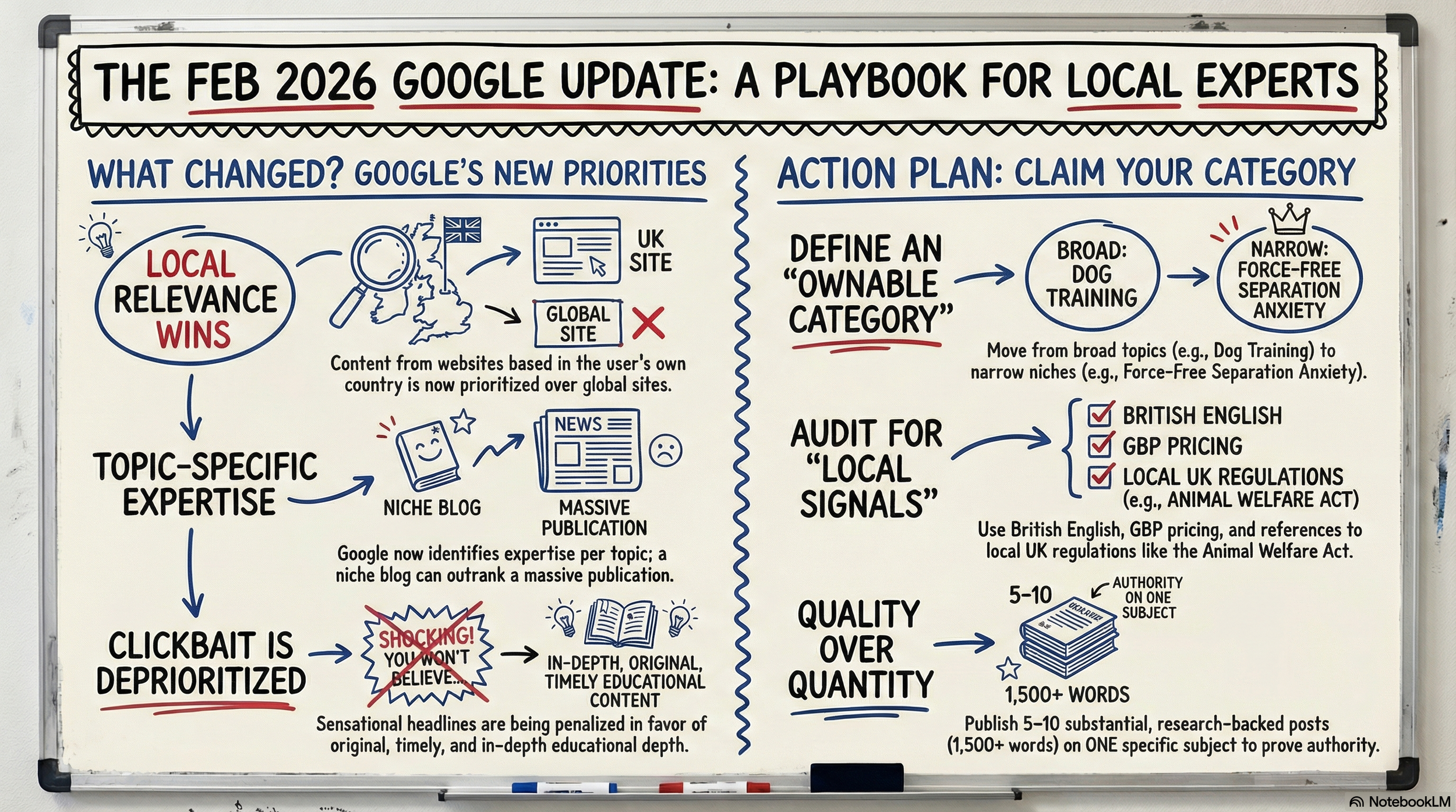
The End of Global Dominance: Why the Feb 2026 Update is a Win for Local Businesses.
WHY THIS UPDATE VALIDATES PETBIZAI’S METHODOLOGY
For the past 18 months, PetBizAI has taught pet business owners to focus on Answer Engine Optimisation (AEO) rather than traditional SEO tricks. AEO prioritises:
Answering specific questions pet owners are actually asking
Demonstrating expertise through detailed, original content
Building topical authority in narrow niches rather than broad coverage
Creating educational resources instead of promotional material
Google’s February update essentially codified these principles into its ranking algorithm.
According to the official Google Search Central Blog post, the update will “show more in-depth, original, and timely content from websites with expertise in a given area, based on our systems’ understanding of a site’s content.” This is AEO in action—Google’s systems are getting better at understanding genuine expertise versus surface-level content.
THE OPPORTUNITY HIDDEN IN THIS CHAOS
While most pet businesses panic about traffic fluctuations or try to reverse-engineer the new algorithm, there’s a massive strategic opportunity available right now.
Here’s what’s happening:
Competitors are distracted by algorithm changes and traffic volatility
Many will chase short-term fixes (buying backlinks, keyword stuffing, paying for traffic)
Smart businesses will use this moment to claim ownable categories
What Is an Ownable Category?
An ownable category is a specific niche within your field where you can credibly claim to be THE expert, not just another option.
Examples for pet businesses:
Instead of: “Dog grooming in Manchester” Own: “Canine skin health specialist for atopic dermatitis in Greater Manchester”
Instead of: “Dog training in Bristol” Own: “Separation anxiety rehabilitation using force-free methods in Bristol”
Instead of: “Canine hydrotherapy” Own: “Post-operative mobility rehabilitation for working dogs in Yorkshire”
Google’s update explicitly rewards this approach. By demonstrating “expertise in a given area” with “in-depth, original” content, you’re signalling to Google’s systems that you OWN this category.
THREE ACTIONS TO TAKE THIS WEEK
Action 1: Audit Your Content for UK Signals
Google is prioritising “locally relevant content from websites based in their country.” Make sure your content clearly signals UK relevance.
Checklist:
Pricing shown in GBP (not USD or generic “from £X”)
Location references include British cities and regions
Business examples reference UK regulations (Animal Welfare Act 2006, GDPR, UK business structures)
Spelling and terminology are British English (behaviour, not behaviour, grooming salon, not grooming parlour)
Images include UK context when possible (British street scenes, UK weather, regional architecture)
About page clearly states UK location and service area
Quick win: Add a location qualifier to your next three blog posts. Instead of “How to Help Anxious Dogs,” write “How Manchester Dog Owners Can Help Anxious Dogs: A Local Trainer’s Guide.”
Action 2: Identify ONE Topic You Can Own
Review your expertise and local competition. Find the intersection of:
What you’re genuinely knowledgeable about (10+ client cases, specialized training, unique methodology)
What local competitors aren’t covering in depth (surface-level content or no content at all)
What pet owners in your area are actively searching for (problems you solve repeatedly)
Once you’ve identified your category, commit to publishing at least 5-10 pieces of substantial content (1,500+ words each) demonstrating depth in that specific area over the next 3-6 months.
Action 3: Publish Educational Depth, Not Promotional Fluff
Google’s penalising clickbait and rewarding “in-depth, original, and timely content.” Shift your content strategy from promotional to educational.
Instead of writing:
“Why Our Grooming Salon Is the Best in Leeds”
“10 Reasons to Choose Our Dog Training Program”
“Book Your Puppy’s First Appointment Today!”
Write:
“The Complete Guide to Managing Canine Atopic Dermatitis: Bathing Protocols, Product Selection, and When to See a Vet”
“Evidence-Based Approaches to Leash Reactivity: What Current Research Tells Us About Force-Free Methods”
“Post-Operative Hydrotherapy Timelines: When to Start, What to Avoid, and How to Progress Safely”
Notice the difference? The second set answers specific questions, demonstrates expertise, and provides genuine value to pet owners, even if they never become clients.
That’s the point: Educational content builds trust and authority. When someone needs your service, you’re already the trusted expert in their mind.
WHAT HAPPENS NEXT
According to Google’s announcement, the February 2026 Discover core update is “releasing to English language users in the US, and will expand to all countries and languages in the months ahead.”
This means UK pet businesses have a critical window—likely 2-4 months—to establish topical authority before the update fully rolls out to British users.
Search Engine Land notes that “some sites might see increases or decreases; many sites may see no change at all” in Discover traffic. But here’s what matters more than immediate traffic fluctuations: the strategic direction Google is signalling.
This update isn’t an isolated change. It’s part of Google’s broader shift toward:
E-E-A-T principles (Experience, Expertise, Authoritativeness, Trustworthiness)
Answer Engine Optimisation over traditional keyword targeting
Local, relevant expertise over generic global content
Educational depth over promotional surface-level material
Pet businesses that align with these principles now will benefit not just from this Discover update, but from every future algorithm refinement Google makes.
THE UNCOMFORTABLE QUESTION
Here’s what most marketing advice won’t tell you: this update exposes a hard truth about your current content strategy.
If your website traffic is heavily dependent on Google Discover or search rankings, and this update causes volatility, it reveals a strategic vulnerability: you don’t own a category yet.
Businesses that truly own their category don’t panic about algorithm updates. Why? Because they’ve built direct relationships with their audience through:
Email lists of engaged subscribers
Referral networks from past clients
Community presence in local pet owner groups
Reputation as THE go-to expert for a specific problem
Google’s algorithm should amplify your expertise, not create it. If you’re chasing algorithm changes rather than building genuine authority, you’re playing a game you can’t win long-term.
The fix: Use this update as motivation to claim your ownable category, publish educational content consistently, and build direct relationships with your ideal clients.
FINAL THOUGHTS
Google’s February 2026 Discover update isn’t a crisis; it’s clarification. Google is explicitly telling you what works: local expertise, educational depth, and topic-specific authority.
Most pet businesses will treat this as another algorithm update to worry about. Smart ones will use it as the catalyst to finally claim their category.
The question isn’t whether Google’s algorithm will change again (it will). The question is: when it does, will you be the established expert in your category, or still competing with everyone else in a saturated market?

About the Author
Kirsty Skeates is the founder of PetBizAI, an AI consultancy helping UK pet business owners leverage artificial intelligence for marketing and operations. With over 10 years of experience in the pet industry working with groomers, trainers, physiotherapists, and hydrotherapists, Kirsty specialises in translating complex AI and marketing concepts into practical, implementable strategies for busy pet professionals.
Reference Citations (APA Style for Credibility)
Mueller, J. (2026, February 5). Google's February 2026 Discover core update. Google Search Central Blog. https://developers.google.com/search/blog/2026/02/discover-core-update
Sullivan, D. (2026, February 5). Google releases the Discover core update for February 2026. Search Engine Land. https://searchengineland.com/google-releases-discover-core-update-february-2026-468308
