Does Your Pet Business Really Need Terms and Conditions?
Running a pet business is built on trust, trust between you, your clients, and their animals. But trust alone won't protect you if something goes wrong. Terms and Conditions (T&Cs) are the legal safety net that sits behind every booking, every service, and every client relationship. Most pet business owners either don't have them, or are using a template they found online that doesn't actually reflect how they work. This guide explains why that matters, and what you can do about it, without needing a solicitor or a legal degree.

Terms and Conditions
“Trust builds your pet business. Terms and Conditions protect it when trust is tested.”
What are the Terms and Conditions for a Pet Business?
Terms and Conditions are a legally binding agreement between you and your client that sets out what each party can expect from the other. They cover how you work, what happens if things go wrong, your cancellation policy, liability limits, and your rights as a service provider. Without them, disputes are settled by whoever shouts loudest — or by a court.
For pet businesses specifically, T&Cs also address things that are unique to working with animals: health declarations, vaccination requirements, emergency veterinary consent, and what happens if a pet is injured in your care.
Why Do Pet Businesses Get Caught Out Without T&Cs?
Most pet business owners go into business because they love animals, not because they love paperwork. T&Cs feel like something "bigger" businesses need. But the truth is, sole traders and small pet businesses are actually more vulnerable, not less, because they don't have a legal team to fall back on.
Common situations where missing T&Cs cause real problems include:
A client demands a refund after a late cancellation
A dog gets injured during a walk, and the owner blames you
A grooming appointment goes wrong, and the client threatens legal action
A client simply refuses to pay
Without T&Cs in place, you have very little ground to stand on in any of these situations.
What Should Pet Business Terms and Conditions Include?
Good Terms and Conditions for a pet business should cover the following core areas:
Services provided — exactly what you offer and what's excluded
Booking and payment terms — how and when clients pay, and what your deposit policy is
Cancellation and refund policy — your terms for late cancellations and no-shows
Health and vaccination requirements — what you need from clients before accepting their pet
Emergency veterinary consent — your authority to seek emergency care and who pays
Liability and insurance — what you are and aren't responsible for
Photography and social media consent — your right to share images of pets in your care
Data protection — how you handle client information under UK GDPR
Each of these sections needs to reflect your business, not a generic template.
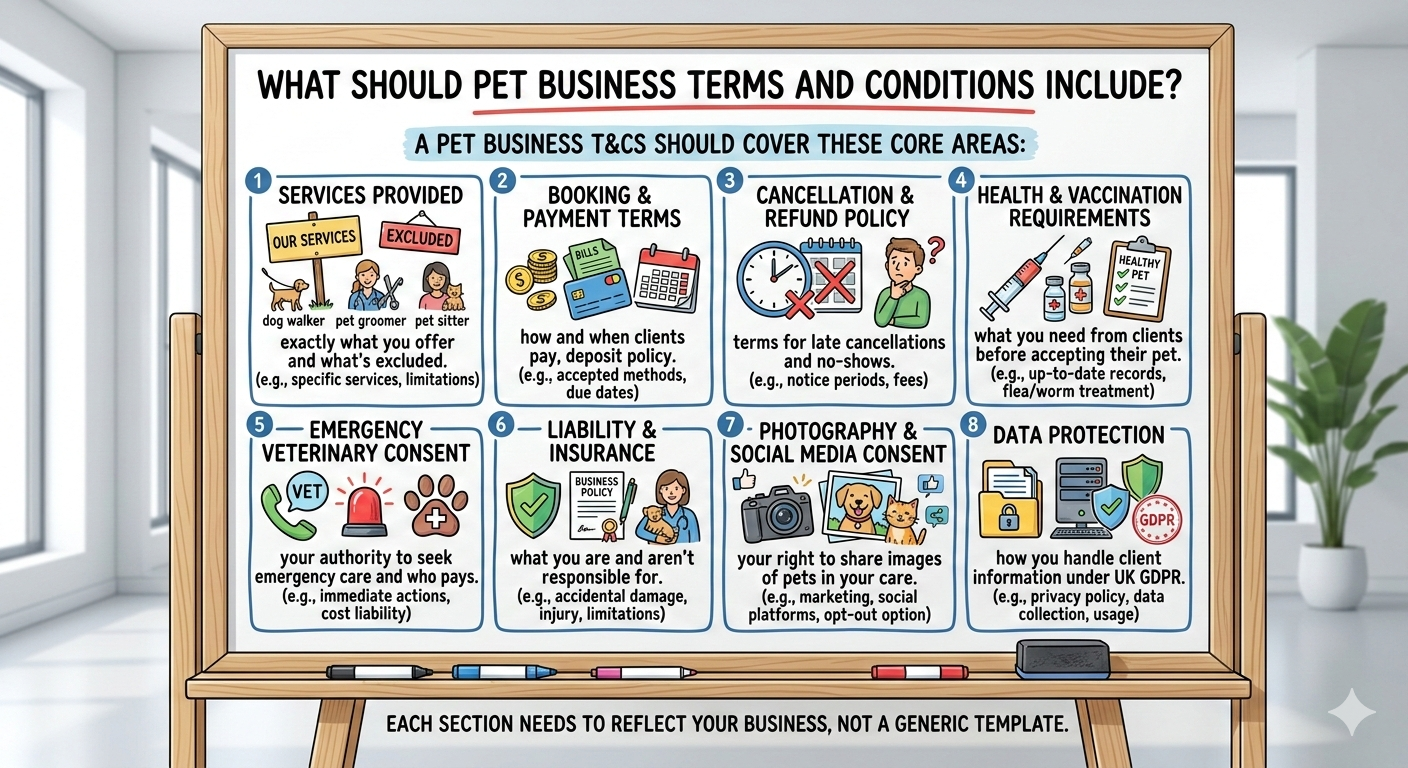
A whiteboard infographic illustrating essential pet business T&Cs in eight numbered panels: 1. Services Provided (walker, groomer), 2. Booking & Payment, 3. Cancellation Policy, 4. Health & Vaccinations, 5. Emergency Vet Consent, 6. Liability & Insurance, 7. Photography & Social Media, and 8. Data Protection (GDPR). The overall theme is tailored terms for individual businesses
Are T&Cs a Legal Requirement for Pet Businesses in the UK?
Strictly speaking, no — there is no law that forces you to have Terms and Conditions. But that doesn't mean you shouldn't have them. Under UK consumer law and the Consumer Rights Act 2015, any contract (even a verbal one) is legally binding. The problem is that without written T&Cs, proving what was agreed becomes very difficult.
Having clear, written T&Cs:
Reduces the risk of misunderstandings with clients
Protects you in the event of a complaint or dispute
Shows professionalism and builds client trust
Is often required by insurers when making a claim
How Hard Is It to Create Terms and Conditions for a Pet Business?
Writing T&Cs from scratch used to be time-consuming and expensive — but that's changed. AI tools designed specifically for pet businesses can now generate a customised set of Terms and Conditions based on your services, location, and how you work. You don't need to hire a solicitor for a starting point.
PetBizAI's T&C Assistant at petbizai.app is built specifically for pet businesses in the UK. It asks you a series of simple questions about your business and generates a full set of T&Cs tailored to your services — in minutes.
The Bottom Line: Do You Need T&Cs?
Yes. If you take bookings, handle other people's animals, or charge for a service, you need Terms and Conditions. They don't need to be complicated or intimidating — but they do need to exist, and they need to reflect how your business actually works.
The good news? Creating them has never been easier.
→ Ready to create your Terms and Conditions? Try the T&C Assistant at petbizai.app — no legal knowledge required.
→ Read next: What Should Be in a Pet Business's Terms and Conditions? (Post 2)
Related Pet Business Legal Guides
Explore more guides on creating, understanding and managing Terms and Conditions for your pet business.



Kirsty Skeates
I spent years running Fit4DogsUK, my canine hydrotherapy centre, and I learned the hard way that loving what you do isn't enough to protect your business. Solid Terms and Conditions were one of the most important things I put in place — and they're the reason the T&C Assistant exists." — Kirsty Skeates, Founder of PetBizAI

Many pet businesses have Terms and Conditions, but they’re often copied, outdated, or too vague to offer real protection. This guide explains the most common T&C mistakes pet businesses make and how clearer policies or the PetBizAI T&C Assistant can help prevent disputes around cancellations, payments, and client expectations.