What Should Be in a Pet Business's Terms and Conditions? (UK Guide)
A lot of pet business owners either skip Terms and Conditions entirely, or use a template that doesn't actually cover what they do. The result? Avoidable disputes, awkward client conversations, and no legal protection when things go wrong. This guide breaks down every section your T&Cs should include, in plain English — so you know exactly what you're agreeing to (and what you're protecting yourself from).

A pet business owner signs a terms and conditions document on a clipboard while a dog relaxes in the background, symbolising the agreements and policies that protect pet businesses and their clients.
Why Does the Content of Your T&Cs Actually Matter?
Vague or incomplete Terms and Conditions offer little real protection. If your T&Cs don't specifically address a situation, say, what happens when a client cancels two hours before an appointment, you're likely to end up absorbing the cost yourself. Specific, clearly written T&Cs remove the grey areas that lead to disputes.
Think of your T&Cs less like legal small print and more like a very clear conversation with every client before they ever book. The clearer you are upfront, the fewer problems you'll face later.
What Are the Essential Sections Every Pet Business T&Cs Need?
Here's a breakdown of the core sections your Terms and Conditions should include, and what each one actually does for you.
1. Services Description
This section defines exactly what you offer — and crucially, what you don't. It prevents clients from assuming services are included that you never intended to provide.
For a dog groomer, this might specify which breeds or coat types you accept. For a dog walker, it might clarify group versus solo walks. For a trainer, it could define what your sessions cover and what falls outside your scope.
Being specific here saves arguments later.
2. Booking, Payment, and Deposit Terms
This section covers how clients book, how they pay, and what happens if payment isn't made on time. It should include:
How bookings are confirmed (e.g., deposit required to secure a slot)
Accepted payment methods
When final payment is due
What happens if a client doesn't pay
If you take deposits, your T&Cs must state whether they are refundable or non-refundable, and under what circumstances.
3. Cancellation and Refund Policy
This is one of the most important sections for protecting your income. It sets out your terms for late cancellations, no-shows, and rescheduling.
A clear cancellation policy might state:
Cancellations with 48+ hours notice: full refund or reschedule
Cancellations with less than 24 hours notice: deposit forfeited
No-shows: full session fee charged
Without this in writing, clients will argue — and often win — simply because nothing was agreed.
4. Health and Vaccination Requirements
Pet businesses have a duty of care not just to individual animals, but to every animal in their care. This section sets out the minimum health standards you require before accepting a booking.
Typical requirements include:
Up-to-date vaccinations (specify which — parvovirus, kennel cough for walkers, etc.)
Flea and worm treatment
Disclosure of any known health conditions or behavioural issues
The right to refuse service if health requirements aren't met
This protects other animals, and protects you from liability if a pet you've accepted transmits illness.
5. Emergency Veterinary Consent
This section is non-negotiable if you handle animals. It gives you authority to seek emergency veterinary treatment if a pet in your care becomes ill or injured — and sets out who bears the cost.
Without this clause, you could be in a position where you're legally uncertain whether you can authorise treatment for an animal that urgently needs it.
The clause should specify:
Your right to make decisions in a genuine emergency
Your obligation to contact the owner as soon as possible
That the owner is responsible for all veterinary costs incurred
6. Liability and Insurance
This section sets out what you are — and aren't — responsible for. It should confirm that you hold appropriate public liability insurance and clarify the limits of your liability.
Common inclusions:
You are not liable for pre-existing conditions that weren't disclosed
Your liability is limited to the cost of the service provided (unless negligence is proven)
You are not liable for indirect losses (e.g., a client taking time off work because their appointment was cancelled)
This doesn't mean you can avoid responsibility if you're genuinely negligent — but it does protect you from inflated claims.
7. Photography and Social Media Consent
Most pet businesses photograph animals in their care for marketing and social media. Without consent, you could be in breach of your client's rights — even for pictures of their pet.
This clause should:
State that you may photograph or video animals in your care
Confirm how images may be used (website, social media, marketing)
Allow clients to opt out without affecting their service
8. Data Protection (UK GDPR)
If you hold client information — names, addresses, phone numbers, pet health records — you are processing personal data under UK GDPR. Your T&Cs should reference your Privacy Policy and confirm how you handle client data.
Key points to include:
What data you collect and why
How long you retain it
That you won't share it with third parties without consent
How clients can request their data be deleted
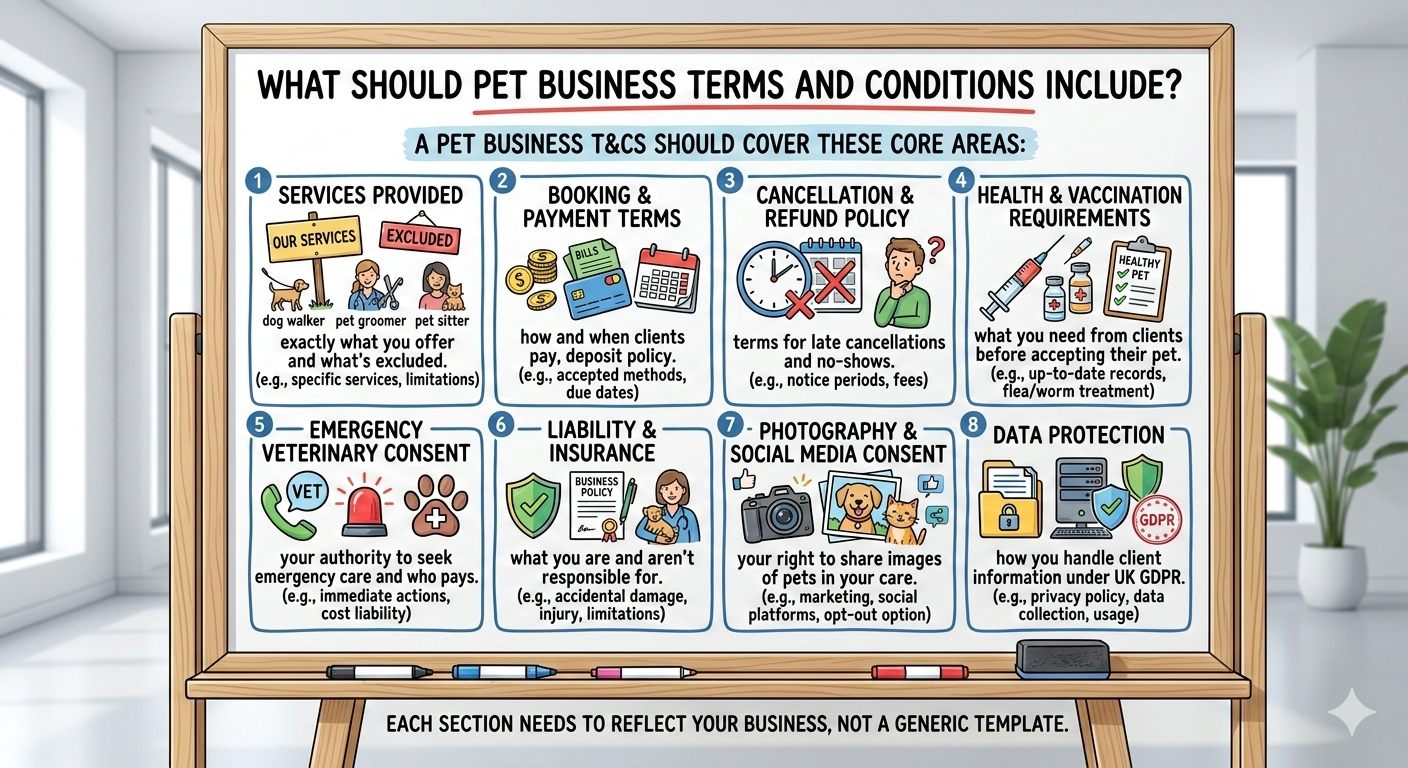
Illustrated infographic showing the key sections every pet business Terms and Conditions should include, such as services provided, booking and payment terms, cancellation and refund policy, health and vaccination requirements, emergency veterinary consent, liability and insurance, photography consent, and data protection. Created with Nano Banana in Petbizai.app
How Long Should Pet Business T&Cs Be?
There's no set length — but clarity matters more than length. T&Cs that are too brief leave gaps; T&Cs that are too long won't be read. A well-structured document of 800–1,500 words typically covers everything a pet business needs without overwhelming clients.
Use plain English wherever possible. If a client can't understand your T&Cs, they're less likely to read them — and more likely to dispute them later.
Do You Need a Solicitor to Write Pet Business T&Cs?
For most small pet businesses, a solicitor is not required to create a solid first set of T&Cs. AI tools now make it possible to generate professionally worded, tailored T&Cs based on your specific services in a fraction of the time and cost of traditional legal advice.
The PetBizAI T&C Assistant at petbizai.app is designed for exactly this purpose. It walks you through the key sections, asks the right questions about your business, and produces T&Cs you can implement straight away.
Note: For complex situations or if you face a specific legal dispute, always seek professional legal advice.
Create Your Pet Business Terms and Conditions in Minutes
→ Want T&Cs tailored to your pet business? Try the T&C Assistant at petbizai.app — built for groomers, walkers, trainers, and more.
→ Read next: How to Use the PetBizAI T&C Assistant: A Step-by-Step Guide (Post 3)
→ Missed Post 1? Does Your Pet Business Really Need Terms and Conditions?




Many pet businesses have Terms and Conditions, but they’re often copied, outdated, or too vague to offer real protection. This guide explains the most common T&C mistakes pet businesses make and how clearer policies or the PetBizAI T&C Assistant can help prevent disputes around cancellations, payments, and client expectations.