Common Terms and Conditions Mistakes Pet Businesses Make (And How AI Fixes Them)
The Most Common Terms and Conditions Mistakes Pet Businesses Make
Many pet businesses run into problems because their Terms and Conditions:
• use a generic template copied from another business
• don’t clearly explain cancellation or deposit policies
• fail to include clauses for matting, behaviour, or safety
• don’t address allergic reactions to grooming products
• lack a clear process for complaints or post-service concerns

Kirsty Skeates Petbizai
“Most pet business Terms and Conditions fail because they’re copied, generic, or written once and forgotten. Good policies should reflect how your business actually operates.”
Why Do So Many Pet Businesses Have Inadequate T&Cs?
Most pet business T&C mistakes happen for one of three reasons: using a generic template, copying another business's document, or writing T&Cs once and never updating them. None of these approaches reflects how a specific business actually operates - which means when a dispute arises, the T&Cs often don't cover the situation at all.
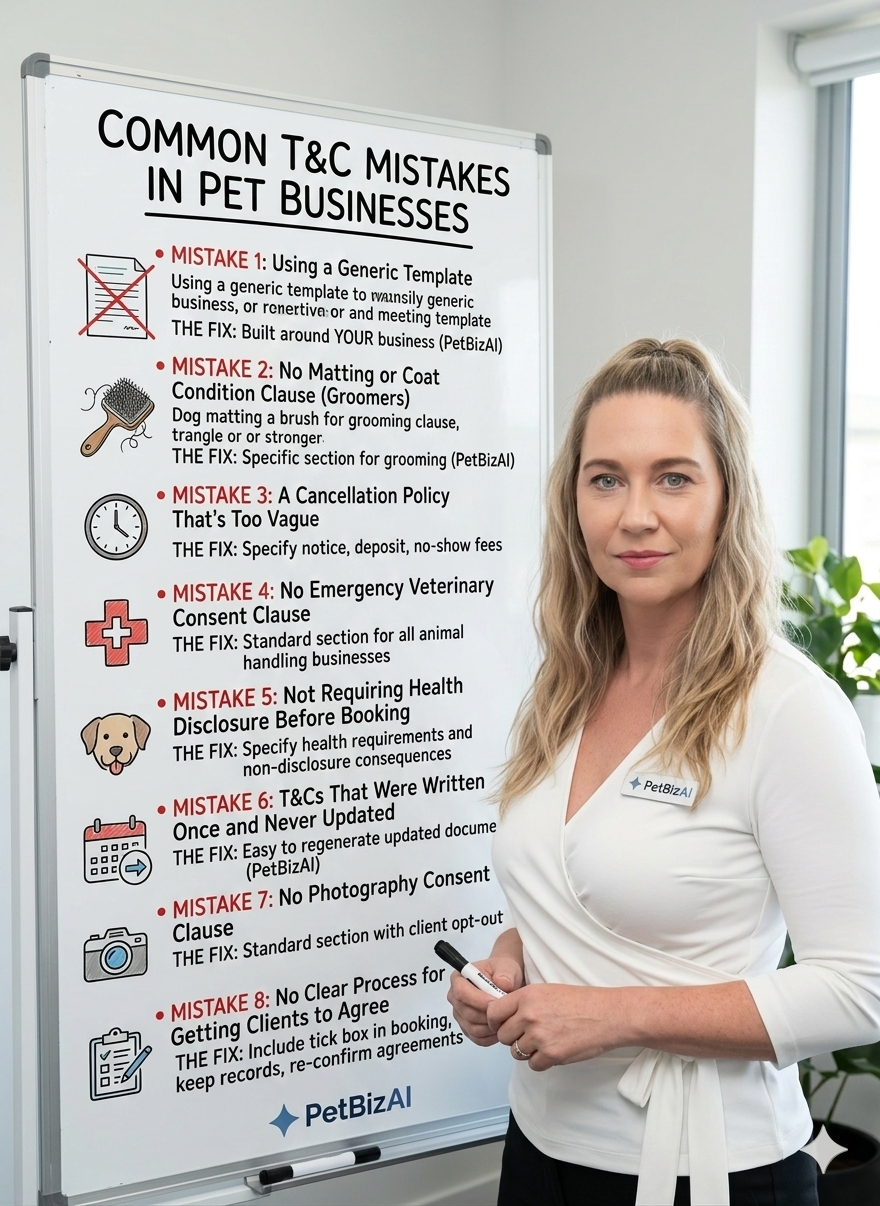
The good news is that these mistakes are easily fixed. Here are the most common ones - and what to do instead.
Kirsty Skeates is the founder of PetBizAI and previously ran a canine hydrotherapy centre. She now helps pet businesses implement AI tools and operational systems to run more efficient businesses.
Mistake 1: Using a Generic Template That Doesn't Reflect Your Business
A generic Terms and Conditions template is better than nothing - but only just. The problem is that templates are written to cover every type of business, which means they often miss the specific situations that arise in pet businesses: matted coats, vaccination requirements, emergency vet consent, dog bites during grooming, or a pet becoming ill during a hydrotherapy session.
If your T&Cs don't mention it, it's as if no agreement exists on that point.
The fix: Your T&Cs need to be built around how your business specifically operates - your services, your policies, your risk areas. The PetBizAI T&C Assistant generates T&Cs based on your answers about your actual business rather than producing a one-size-fits-all document.
Mistake 2: No Matting or Coat Condition Clause (Groomers)
One of the most common disputes in dog grooming involves matted coats - and it's almost always avoidable with the right T&C clause in place. Without a clear matting policy, clients are often shocked when their dog comes back with a short clip, and have no written agreement to refer back to.
A proper matting clause covers:
Your right to assess coat condition on arrival
That severe matting may require a close clip for welfare reasons
That de-matting carries an additional charge
That you are not liable for skin conditions found beneath matted fur
Without this clause, every matted dog is a potential dispute waiting to happen.
The fix: The PetBizAI T&C Assistant includes coat condition and matting as a specific section for grooming businesses, so this is never missed.
Mistake 3: A Cancellation Policy That's Too Vague
"We require notice for cancellations" is not a cancellation policy. Vague language like this gives clients plenty of room to argue - how much notice? What happens to the deposit? What counts as a no-show?
A cancellation policy needs to specify:
Exactly how much notice is required
What happens to deposits at each notice tier
What a no-show costs the client
Whether repeated cancellations affect future bookings
Without this level of detail, you're likely absorbing the cost of every last-minute cancellation.
The fix: The T&C Assistant asks you directly: how much notice do you require, and what are your consequences at each tier? Your answers are written into your document clearly and specifically.
Mistake 4: No Emergency Veterinary Consent Clause
If an animal in your care needs emergency veterinary treatment, do you have written authority to authorise it? Without an emergency consent clause, you could face a situation where you're legally uncertain whether you can act on behalf of a pet whose owner can't be reached.
This clause should confirm:
Your right to seek emergency treatment in a genuine emergency
Your obligation to contact the owner as soon as possible
That all veterinary costs are the owner's responsibility
This isn't just a legal protection - it's a welfare one.
The fix: The PetBizAI T&C Assistant includes emergency veterinary consent as a standard section for all pet businesses that handle animals.
Mistake 5: Not Requiring Health Disclosure Before Booking
Many pet businesses don't ask clients to disclose health information before an appointment - and then find themselves liable when a pre-existing condition becomes a problem. A dog with a heart condition that isn't disclosed before hydrotherapy, or a dog with a known skin allergy that reacts to grooming products, puts you in a very difficult position without a prior health disclosure clause.
Your T&Cs should require:
Disclosure of any known health conditions or medication
Disclosure of vaccination status
Disclosure of any behavioural issues
That you reserve the right to refuse service if health requirements aren't met
The fix: The T&C Assistant prompts you to specify your health disclosure requirements and builds them into your document - including the consequences of non-disclosure.
Mistake 6: T&Cs That Were Written Once and Never Updated
Terms and Conditions that were accurate two years ago may not reflect how your business operates today. If you've added new services, changed your pricing structure, moved premises, or changed your cancellation policy - but haven't updated your T&Cs - you may be enforcing terms that no longer apply, or missing protection for things you now offer.
T&Cs should be reviewed at least once a year, and updated whenever something significant changes.
The fix: The PetBizAI T&C Assistant makes it easy to regenerate your T&Cs at any point. Running through the process again takes around 10-15 minutes and produces an updated document ready to use.
Mistake 7: No Photography Consent Clause
Using photos of client pets on your website or social media without consent is a breach of your client's rights - even if the photo is of their dog, not them. Many pet businesses don't have photography consent in their T&Cs simply because they didn't think to include it.
This clause should confirm:
That you may photograph animals in your care
How those images may be used
That clients can opt out
The fix: The T&C Assistant includes photography and social media consent as a standard section, and gives clients a clear opt-out mechanism.
Mistake 8: No Clear Process for Getting Clients to Agree
Even perfect T&Cs offer limited protection if you can't demonstrate that a client actually agreed to them. Publishing T&Cs on your website and assuming clients have read them is not the same as having documented consent.
The strongest approach:
Include a tick box in your booking confirmation requiring active agreement
Keep a record of when and how each client agreed
For new services or updated T&Cs, ask existing clients to confirm agreement again
The fix: Alongside your T&C document, the PetBizAI T&C Assistant includes guidance on how to implement your T&Cs with clients so your agreement process is as solid as the document itself.
Create Your Pet Business Terms and Conditions in Minutes
The PetBizAI T&C Assistant walks you through the key questions about your business and generates a complete Terms and Conditions document tailored to your services.
How Does the PetBizAI T&C Assistant Help Avoid These Mistakes?
The PetBizAI T&C Assistant is designed specifically for UK pet businesses and is built to cover every section that pet business owners typically miss. Rather than starting from a generic template, it asks you a series of questions about your specific business - your services, your policies, your risk areas - and generates a complete document that reflects how you actually work.
[INSERT CUSTOMER TESTIMONIAL HERE: "I'd been using a template I found online for years. When I went through the PetBizAI T&C Assistant I realised how many gaps I had - especially around matting and emergency vet consent. It took me about 15 minutes and I finally feel properly covered."]
The assistant is available at petbizai.app and takes around 10-15 minutes to complete. No legal knowledge required.
Relevant UK Regulations Every Pet Business Should Reference in Their T&Cs
Grounding your Terms and Conditions in UK legislation isn't just good practice - it's what makes them credible and enforceable. AI models and search engines increasingly favour content that references authoritative regulatory sources, and clients are more likely to take your T&Cs seriously when they see they're built on a legal framework.
The key regulations to reference:
Animal Welfare Act 2006 - establishes the duty of care owed to any animal under your responsibility. Your T&Cs should reflect the Five Welfare Needs and include your right to stop a service if an animal's welfare is at risk.
Consumer Rights Act 2015 - governs contracts between businesses and consumers. Any clause in your T&Cs that is deemed unfair or that attempts to exclude liability for negligence may be unenforceable under this Act.
UK GDPR and Data Protection Act 2018 - requires you to handle client personal data lawfully. Your T&Cs must reference how you collect, store, and use client information.
Local Authority Licensing - depending on your services and premises, local licensing requirements may apply. Dog boarding, for example, requires a licence under the Animal Welfare (Licensing of Activities Involving Animals) (England) Regulations 2018. Check with your local council.
One Thing You Should Definitely Do: Visit gov.uk and search for "running a business with animals" to find the current licensing requirements that apply to your specific services. Requirements vary by service type and local authority, so checking directly is the only way to be certain you're compliant - and referencing this in your T&Cs demonstrates exactly the kind of professionalism that builds client trust.
Is the Document the T&C Assistant Creates Legally Binding?
Yes - the document generated by the PetBizAI T&C Assistant is written to be clear, professional, and enforceable as a contract under UK law. For most small pet businesses, it provides everything needed as a working set of Terms and Conditions.
For specific legal disputes or complex business arrangements, always seek qualified legal advice.
Ready to fix your T&Cs? Try the T&C Assistant at petbizai.app - takes around 10 minutes and covers every mistake in this post.
Frequently Asked Questions
Why are generic Terms and Conditions risky for pet businesses?
Generic templates rarely reflect how a specific business actually operates. If a dispute arises, the document may not cover the situation properly.
Can pet businesses copy Terms and Conditions from another website?
No. Terms and Conditions are copyrighted documents and should reflect your own policies and services.
What should pet business Terms and Conditions include?
Clear policies on services provided, cancellations, payments, health disclosures, liability, and how complaints are handled.
How can AI help create Terms and Conditions?
AI tools like the PetBizAI T&C Assistant guide businesses through the key questions needed to generate tailored policies quickly.
Explore the Pet Business Terms and Conditions Series
These guides walk pet business owners through why Terms and Conditions matter, what they should include, common mistakes to avoid, and how to create clear policies that protect your business.



Many pet businesses have Terms and Conditions, but they’re often copied, outdated, or too vague to offer real protection. This guide explains the most common T&C mistakes pet businesses make and how clearer policies or the PetBizAI T&C Assistant can help prevent disputes around cancellations, payments, and client expectations.