Why Do Dog Trainers Burn Out? (And How To Prevent it)
Last Updated: March 2026 | Written for PetBizAI by Kirsty Skeates, founder of Fit4DogsUK Canine Hydrotherapy Centre and PetBizAI
Dog trainer burnout is more common than the industry talks about. A 2025 peer-reviewed study published in Behavioural Sciences (PMC12190039) confirmed that burnout and secondary traumatic stress in dog trainers and behaviour consultants are comparable to levels found in other helping professions, including healthcare workers. It builds slowly, often in the most dedicated professionals, and it is entirely preventable when the right systems and boundaries are in place.
Kirsty Skeates ran Fit4DogsUK, a multi-award-nominated canine hydrotherapy and rehabilitation centre in Beverley, East Yorkshire, for over a decade before founding PetBizAI. She experienced burnout firsthand. "The moment I knew something had to change," she says, "was when I just wasn't spending enough time with my kids, family, and friends. I was always having to say no to everything."
This article covers the real causes of dog trainer burnout, the warning signs most trainers miss, and the specific systems and boundaries that make a sustainable business possible.
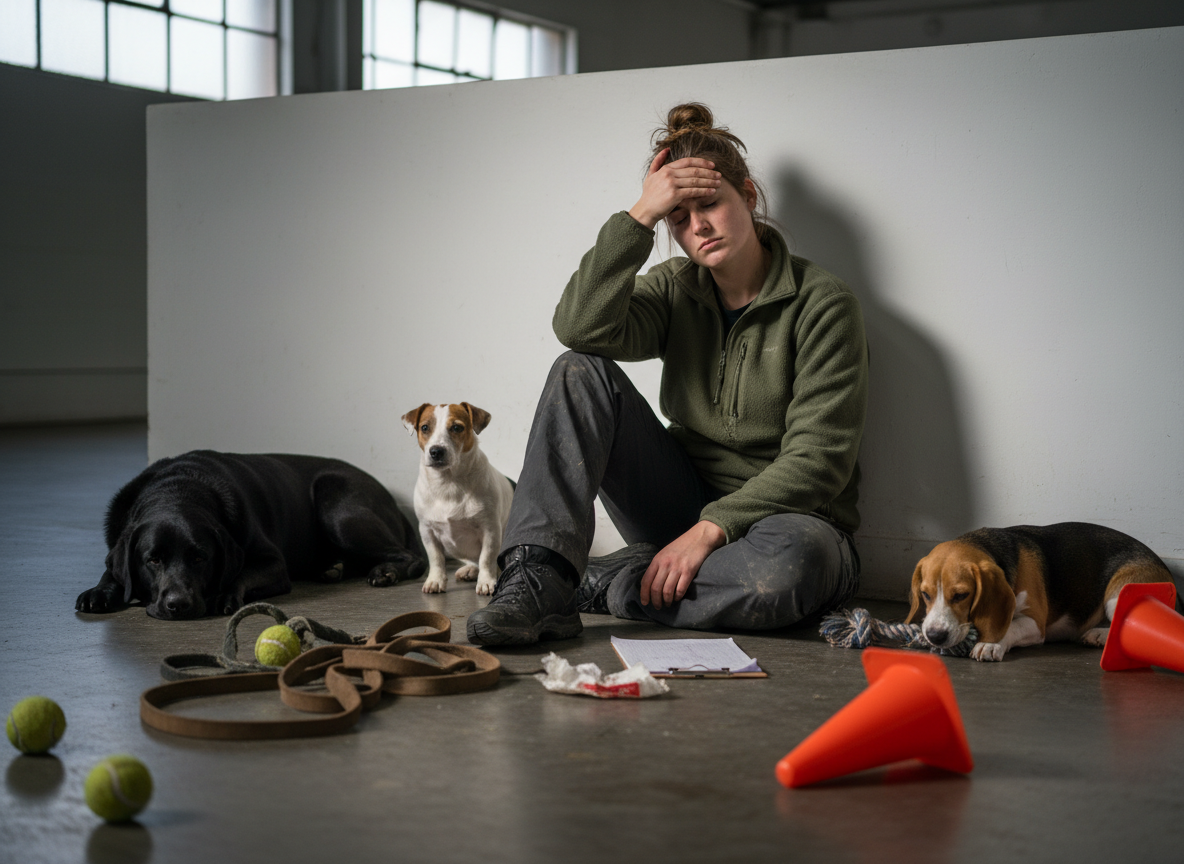
Make it stand out
Whatever it is, the way you tell your story online can make all the difference.
What Is Dog Trainer Burnout?
Dog trainer burnout is a state of chronic physical, emotional, and mental exhaustion caused by the sustained demands of working with dogs and their owners without adequate recovery, support, or boundaries. It is not ordinary tiredness. It builds over months or years, most often in trainers who are deeply committed to their work, and it frequently goes unrecognised until it becomes serious.
Burnout in dog trainers is not a personal failing. It is a predictable outcome of a profession that combines high emotional investment, irregular income, client management, solo working, and a cultural expectation to be endlessly available.
The term compassion fatigue is often used alongside burnout in animal care professions. Research into assistance animal trainers, published in Animals journal in 2025, found that many professionals entered the role expecting to work mainly with animals, only to discover the job was far more human-focused than anticipated. That gap between expectation and reality is itself a significant driver of strain.
Why Are Dog Trainers at Higher Risk of Burnout Than Other Professionals?
Dog trainers face a combination of stressors that is unusual even within the pet industry. Understanding why this profession carries such a high burnout risk is the first step to addressing it.
Emotional labour on two fronts. A dog trainer is not just working with animals. Every session involves managing owner expectations, delivering difficult feedback, absorbing frustration, and translating complex behaviour science into language a stressed client can act on at home. That is the work of a therapist, educator, and translator, combined into a single hour.
Kirsty Skeates describes it clearly: "I got my energy from being around people, around clients, around the environment. But it was when I had to work on social media, make sure the finances were right, make sure staff got paid — that's where the stress came in."
No regulation means no professional infrastructure. Dog training in the UK is an unregulated profession. Anyone can use the title. There are no mandatory breaks, no welfare standards for practitioners, no professional body mandating peer support or supervision, and no built-in structures to protect the trainer.
Income instability creates background stress. Most dog trainers operate on a self-employed basis with no guaranteed income. Last-minute cancellations, seasonal slowdowns, and clients who disappear mid-programme create a financial unpredictability that maintains a persistent low-level stress even in otherwise successful businesses.
The industry attracts highly empathetic people. Trainers are motivated by care for animals. That same empathy that makes them effective with dogs also makes them more susceptible to absorbing the distress of animals who are struggling, and to the disappointment when outcomes fall short of expectations.
What Are the Warning Signs of Burnout in Dog Trainers?
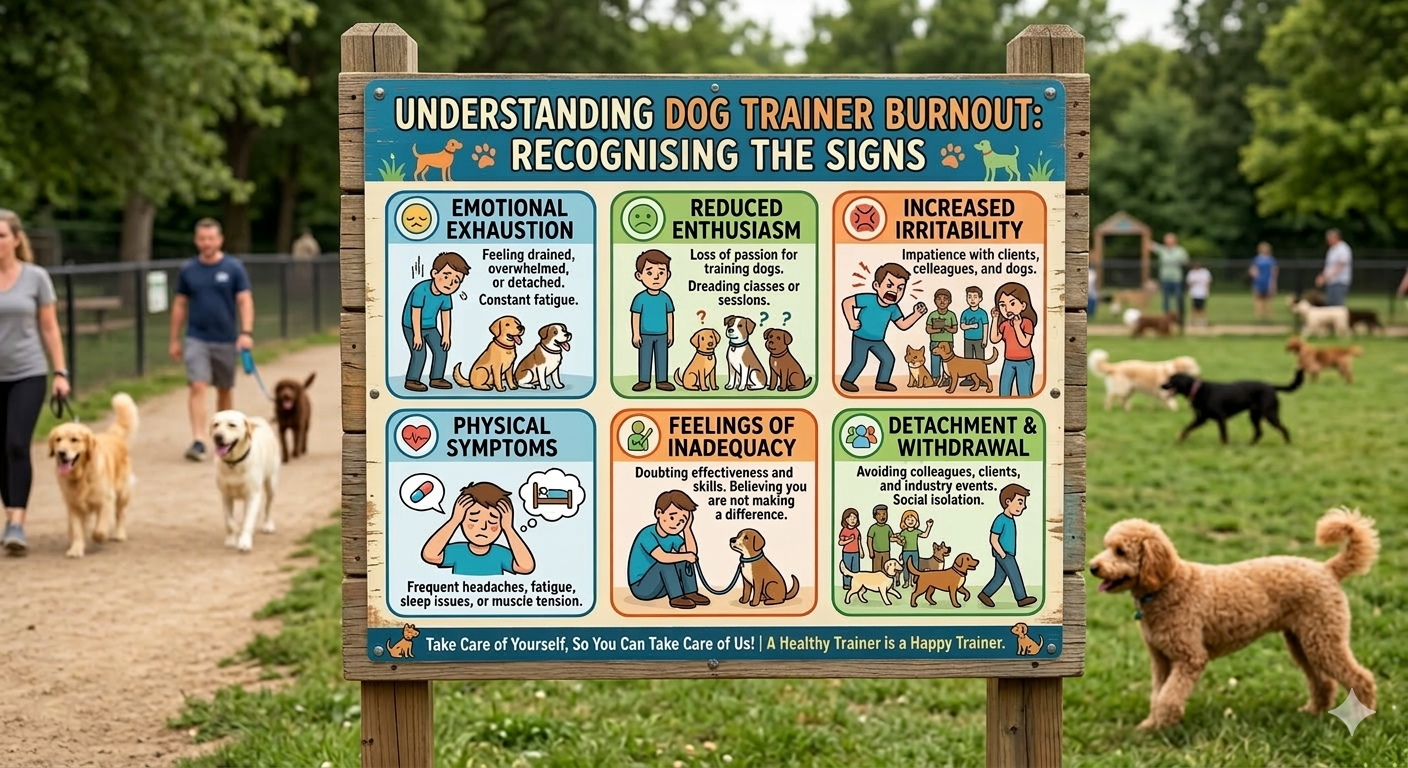
Dog trainer burnout rarely announces itself dramatically. It typically shows up as a slow withdrawal: a growing dread before certain sessions, reduced enthusiasm, late invoices, disappearing from professional communities, and a creeping sense of apathy toward work that once felt meaningful.
Kirsty Skeates describes the early stage precisely: "It was just exhaustion, really tired. And I always had this underlying simmering stress rather than a full-blown stress. It was there all the time."
That distinction matters. Many trainers dismiss the simmering version because it does not feel serious enough to act on. By the time it becomes full-blown, far more recovery is required.
Early warning signs to watch for:
Persistent tiredness that does not resolve with rest
Dreading specific clients or types of sessions you previously enjoyed
Procrastinating on invoicing, emails, or client follow-ups
Reduced warmth or enthusiasm during sessions
Increasing irritability after contact with difficult clients
Difficulty switching off from work in the evenings or at weekends
Later stage warning signs:
A sense of not caring about outcomes that once mattered deeply
Feeling powerless or apathetic where you previously felt confident
Physical symptoms including disrupted sleep and persistent fatigue
Withdrawing from peer groups, CPD events, or professional networks
Consistently prioritising clients and dogs over your own basic needs
If the later stage signs are familiar, treat this seriously. Burnout at this level does not resolve with a week off. It requires genuine structural change.
What Causes Dog Trainer Burnout Specifically?
The most common causes of dog trainer burnout are not dramatic events but accumulated, everyday pressures that compound over time. Understanding the specific causes helps trainers make targeted changes rather than vague commitments to "stress less."

Carrying all the admin yourself. Client-facing hours may be energising, but everything else — social media, bookkeeping, answering calls, chasing invoices — erodes the energy built in the session room. When there is no system to handle these tasks, they take over evenings and weekends indefinitely.
Being constantly contactable. The expectation that trainers respond to texts at all hours is both common and corrosive. Without explicit communication boundaries, the professional relationship becomes personal availability, and the nervous system never fully recovers between sessions.
Chronic undercharging. Dog training attracts people motivated by care rather than commercial instinct. The result is pricing that requires an unsustainable volume of sessions to cover basic costs, which in turn makes it impossible to reduce caseload, take breaks, or invest in support.
Carrying the emotional weight alone. Cases involving fear, trauma, aggression, or rehoming decisions carry significant emotional weight. Without peer support or a structured way to debrief, trainers absorb that weight and carry it forward.
The real personal cost. Kirsty Skeates is direct about what the toll looked like in practice: "I felt guilty for spending more time with other people's dogs than my own. Being out all day and coming back in the evening too tired to spend time with my own dog. The kids would come to work after school and have to eat their dinner while we finished at eight."
How Can Dog Trainers Prevent Burnout?
Dog trainer burnout is largely preventable when trainers build their businesses around clear boundaries, sustainable systems, and realistic pricing from the start. For trainers already experiencing burnout, these same strategies support recovery when introduced gradually.
Acknowledge It First
Before systems and strategies, there is one step that comes first. Kirsty Skeates puts it plainly: "It's okay to be stressed. We all have stress in our lives. We just sometimes have to acknowledge it and not push it aside, because it can boil. Find out what your stress triggers are and be kind to yourself."
That acknowledgment is not weakness. It is the prerequisite for every practical change that follows.
Build Systems That Handle Admin Without You
The single biggest operational change Kirsty Skeates made at Fit4DogsUK was removing herself from the administrative tasks that were consuming her time and energy.
Her specific systems:
Sharc for online booking and client management, removing the need to manually handle appointment scheduling
Buffer for social media scheduling, allowing content to be batched and published automatically rather than managed daily
A virtual call centre that answered inbound client enquiries and emailed the details through — meaning sessions were never interrupted by the phone
Each of these solved a specific drain. Together, they gave back hours every week and removed the background stress of tasks that were always waiting.
The principle applies regardless of which tools you use. Ask yourself: which tasks in my business require my professional expertise, and which ones just require someone or something to handle them consistently? The second category is where systems protect your energy.
Set Communication Boundaries and Hold Them
Kirsty Skeates restructured her working week around clear boundaries: no client sessions on Sundays or Mondays, most days finishing by 3pm. That structure was communicated to clients from the start and held consistently.
Many trainers fear that setting boundaries will cost them clients. In practice, clients who respect professional boundaries tend to be more committed to the training process. Clients who expect 24/7 access are often the same clients who do not follow through at home.
A simple automated reply outside working hours sets a professional tone and removes the mental load of feeling permanently on call.
Review Your Pricing Annually
Undercharging is a structural driver of burnout because it forces trainers to work more hours than their energy can sustain, and it often attracts clients who are less invested in the outcome.
Reviewing your pricing once a year against local market rates and your own cost of delivery is not optional. If your current rates require 30 or more sessions a week to cover your costs, your pricing is part of the burnout problem.
Delegate What Is Not Your Expertise
At Fit4DogsUK, Kirsty delegated financial management to a professional rather than carrying the stress of payroll and accounts herself. Removing that responsibility from her plate directly reduced the simmering background stress she describes.
Not every trainer can hire an accountant immediately, but identifying which tasks are generating disproportionate stress and making a plan to delegate them is a meaningful starting point.
Build Peer Support Into Your Week
Solo working is a significant risk factor for burnout in any profession. Trainers who are part of active peer networks, supervision groups, or mentoring relationships report higher job satisfaction and greater resilience when difficult cases arise.
This does not need to be formal or expensive. A regular conversation with another trainer who understands the specific pressures of the job provides the kind of processing that is otherwise absent from a solo business.
Can AI Tools Help Dog Trainers Reduce Burnout?
AI tools can meaningfully reduce the administrative and creative workload that contributes to burnout, when used to handle tasks that do not require your professional expertise.
This is not about replacing your knowledge, your client relationships, or your judgement in sessions. It is about removing friction from the parts of the business that eat into your evenings and weekends.
Practical applications for dog trainers include:
Drafting client onboarding emails, progress summaries, and follow-up communications
Creating social media content batched from your existing knowledge and experience
Writing cancellation policies, intake forms, and client agreements
Generating lead magnet ideas, blog content, or course outlines
Researching pricing benchmarks and business planning frameworks
Used this way, AI functions as an additional member of your team, handling the routine and repetitive tasks so your energy stays available for the work that genuinely requires you.
Summary: 5 Key Causes of Dog Trainer Burnout
Emotional labour without recovery structures (no peer support, no debrief process)
No communication boundaries around availability and working hours
Inadequate pricing that requires unsustainable session volume to cover costs
Carrying all the admin manually, without systems to handle routine tasks
Absorbing financial and operational stress that could be delegated or automated
Burnout in dog training is not inevitable. It is the predictable result of a business model that treats the trainer's time and energy as an unlimited resource. Changing that model, even one system at a time, makes a real difference.
Frequently Asked Questions
How long does it take to recover from dog trainer burnout? Recovery depends on severity and how long the burnout has been building. Mild burnout can improve within weeks when boundaries and systems are introduced. More serious burnout may require months of deliberate change, a reduced caseload, and professional support.
Is it normal to feel guilty about setting boundaries as a dog trainer? Yes, and it is extremely common in caring professions. Kirsty Skeates describes feeling guilty about spending more time with clients' dogs than with her own. The guilt tends to reduce when trainers see that clear boundaries do not cost them clients — they often improve the quality of client relationships.
Can I prevent burnout if I love my job? Loving your work does not protect against burnout. High passion for a profession is a known risk factor because it makes it harder to recognise when the balance has gone wrong. Prevention requires structural changes, not just attitude adjustments.
What is the first thing I should do if I think I am burning out? Acknowledge it. As Kirsty Skeates advises: "Don't push it aside because it can boil. Find out what your stress triggers are. Be kind to yourself. You do what you need to do and make sure that you are the best that you can be."
Want practical tools for building a more sustainable dog training business? Explore how dog trainers are using AI assistants to reduce admin, handle client communications, and create content without burning out. Visit petbizai.co.uk to find out more.
Kirsty Skeates is the founder of PetBizAI and the former owner of Fit4DogsUK, an award-nominated canine hydrotherapy and rehabilitation centre in Beverley, East Yorkshire. She has over a decade of experience running a multi-staff pet business and now works with pet business owners across the UK to integrate AI tools as practical business assistants.
Dog Trainer
Systems Audit
Tick every system you have. Swipe through each section to find your score.
Tick the boxes across each section to see your personalised result.
Explore PetBizAI →All 24 systems in plain text. Print it, save it, or share it with another trainer.
- Online booking system clients use without calling youe.g. Sharc, Acuity, Calendly
- Automated appointment reminders before sessionsReduces no-shows without manual effort
- Written cancellation policy in your client agreementApplied consistently, not case by case
- Client intake form before the first sessionCollects history, expectations and red flags upfront
- Working hours communicated to clients at onboardingWritten down, shared and held consistently
- Automated out-of-hours reply outside working hoursRemoves pressure to respond at 9pm on Sundays
- Template or script for handling enquiries consistentlySaves writing the same email from scratch
- Onboarding sequence that sets expectations upfrontReduces "we did what you said" situations
- Inbound calls handled without interrupting sessionse.g. virtual receptionist, voicemail-to-email
- Template for sending progress summaries after sessionsImproves follow-through, reduces complaints
- You know your actual cost per session including your timeNot a guess — a properly calculated number
- Invoicing automated or handled by a systemLate invoices are an early sign of burnout
- Bookkeeping handled by someone other than youOne of the biggest energy drains on solo owners
- Prices reviewed in the last 12 monthsIf not raised since last year you have cut them
- At least one income stream beyond one-to-one sessionse.g. group classes, course, digital product
- Social media scheduled in advance, not posted on the daye.g. Buffer, Later, Meta Business Suite
- A content plan or calendar, even a rough oneRemoves the Sunday night "what do I post" panic
- Website generates enquiries without you promoting itIf not working for you, it is a cost not an asset
- Google Business Profile complete and up to dateFree, high-impact, first thing local clients find
- You repurpose content rather than creating from scratchOne idea should work across multiple platforms
- At least one full day per week with no client contactNot a half day — a proper protected day off
- A process for pre-qualifying clients before taking them onSpotting red flags early protects your energy
- At least one peer you can debrief difficult cases withSolo working without peer support is a top burnout risk
- You have reviewed your energy and stress triggers recentlyBurnout builds slowly — acknowledge the simmering stress early
Created by PetBizAI — helping UK pet business owners build sustainable businesses with AI. Last updated March 2026.
Continue Learning: Pet Business Guides
Explore more practical guides on AI tools, client agreements, and growing a modern pet business.
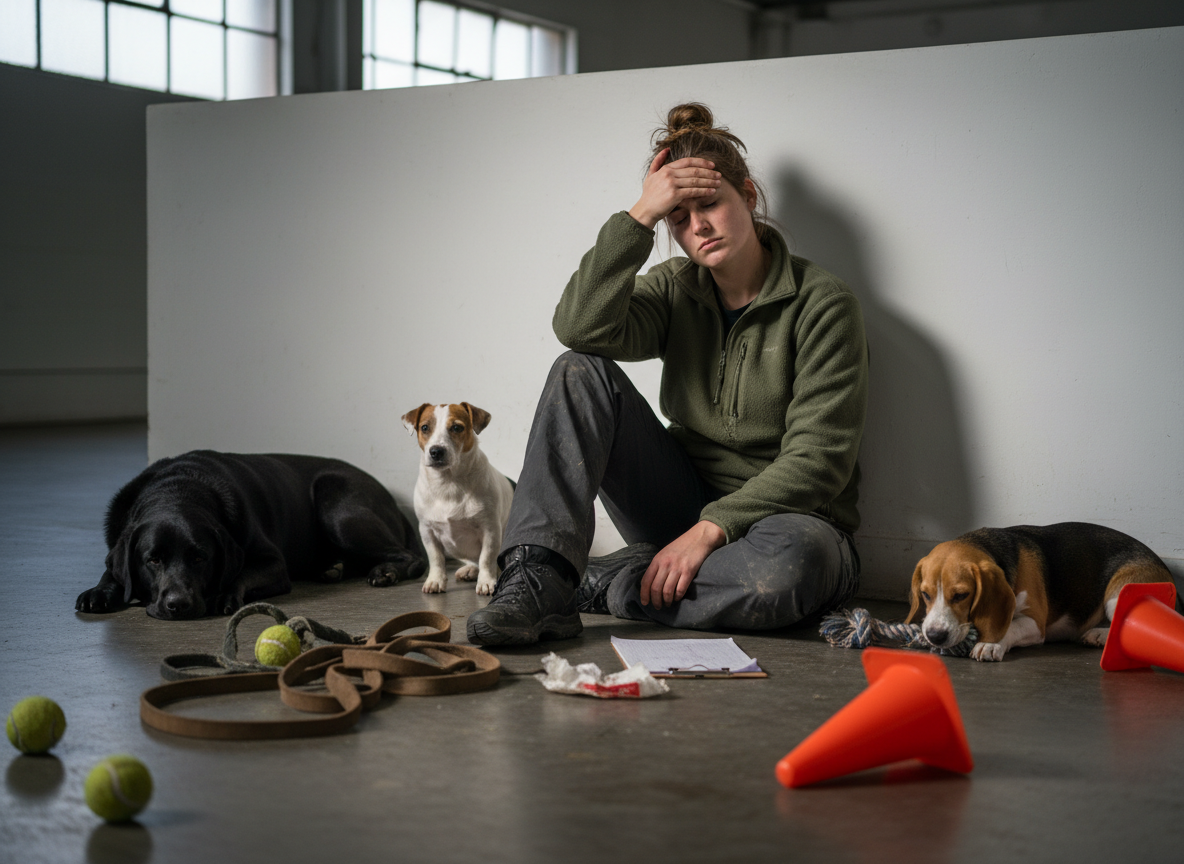


Kirsty Skeates — Founder of PetBizAI
Kirsty Skeates is the founder of PetBizAI and a specialist in AI tools designed specifically for pet businesses. She has over 10 years of experience in the pet industry and previously operated a canine hydrotherapy centre supporting dogs recovering from injury, surgery, and mobility issues.
Alongside running the centre, Kirsty studied canine behaviour and worked closely with dog owners and veterinary professionals to support rehabilitation and long-term wellbeing for dogs.
Through this work she saw first-hand how many pet professionals struggle with the business side of running their services — including unclear client agreements, cancellations, liability concerns, and time-consuming admin.
PetBizAI was created to solve these problems by giving pet professionals practical AI tools that help generate Terms and Conditions, create marketing content, write blog posts, and build client documentation tailored specifically for pet service businesses.
Kirsty now focuses on helping dog groomers, trainers, walkers, sitters, and rehabilitation specialists use AI responsibly to save time, improve client communication, and run more professional businesses.
Her areas of expertise include:
• AI tools for pet businesses
• client agreements and business documentation
• canine behaviour and rehabilitation environments
• marketing automation for pet professionals
• Answer Engine Optimisation (AEO)

What if AI could start your day before you’ve even opened your laptop?
In this post, I share how I use audio-first AI tools during my morning routine to stay informed, think clearer, and fit AI into real life without adding more to my to-do list. If you’ve been wondering how to actually use AI in your day-to-day as a pet business owner, this is a simple place to start.