Why Authenticity Still Wins in an AI World (And What Pet Business Owners Can Do About It)
By Kirsty Skeates, Founder of PetBizAI | Published 2026
What is the biggest challenge facing pet businesses using AI for marketing in 2026?
The biggest challenge for pet businesses using AI in marketing is not the technology itself. It is maintaining trust. As AI-generated content floods social media feeds, consumers are becoming more discerning. Research shows that 25% of pet industry consumers say AI content makes them less likely to trust a brand, and another 25% say it puts them off completely. The good news? There is a clear and practical way through it.
I have been helping pet businesses adopt AI tools for over two years, and I sat down with Kate Hendry from Finnbo Studios and Dan from the Pet Industry Federation to have an honest conversation about this very question. What came out of it surprised even me.
This post breaks down what we discussed, what the research says, and exactly what pet businesses need to do differently in 2026.
Watch the Panel Discussion
What is the biggest challenge facing pet businesses using AI for marketing in 2026?
The biggest challenge for pet businesses using AI in marketing is not the technology itself. It is maintaining trust. As AI-generated content floods social media feeds, consumers are becoming more discerning. Research shows that 25% of pet industry consumers say AI content makes them less likely to trust a brand, and another 25% say it puts them off completely. The good news? There is a clear and practical way through it.
I have been helping pet businesses adopt AI tools for over two years, and I sat down with Kate Hendry from Finnbo Studios and Dan from the Pet Industry Federation to have an honest conversation about this very question. What came out of it surprised even me.
This post breaks down what we discussed, what the research says, and exactly what pet businesses need to do differently in 2026.
Is AI content actually damaging brand trust?
Yes, but only when it is used without a human layer on top. AI content that is generic, unbranded, and indistinguishable from every other business in your industry actively damages trust. But AI content anchored in your real voice, your expertise, and your brand identity builds it. The problem is not AI. It is AI without the human 20%.
During our Pet Industry Federation panel discussion, Kate Hendry shared poll results that stopped the conversation dead. When consumers were asked how they feel about seeing AI content from pet brands:
6% said they were fine with it
44% said yes, as long as it is truthful
25% said it makes them less likely to trust the brand
25% said it puts them off the brand completely
Here is the part that really matters. Some of the same people who said they actively use AI for their own content also said they would not trust another brand for doing the same thing. As I said on the panel: "That is the weird juxtaposition. People are using it to speak to their customers, to sell their wares, but if somebody else did it they would not trust it."
This tells us everything. The problem is not AI. It is the perception of being deceived. It is content that feels hollow because it lacks the real person behind it.
This finding is backed up by independent research. A 2024 Getty Images study of over 30,000 adults across 25 countries found that 98% of consumers agree that authentic images and videos are pivotal in establishing trust with a brand (Getty Images, Building Trust in the Age of AI, 2024). And the 2025 Edelman Trust Barometer found that 73% of people say their trust in a brand increases when it authentically reflects today's culture (Edelman Trust Barometer Special Report: Brand Trust, 2025).
The data and our lived experience in the pet industry are saying exactly the same thing: real wins.
What are the "AI tells" that erode trust with pet owners?
AI tells are the subtle signs that content has been generated without human input or brand context. Think generic phrasing, overly polished language, inconsistent visuals, and a tone that does not match what customers already know about you. In the pet industry, where relationships and trust are everything, these signals are particularly damaging.
Kate Hendry described something on the panel that will resonate with anyone who has spent time on social media:
"There was a time around November last year when everything was slightly sepia-toned. Everything looked the same. These weird cartoony things. And I used to think: why has that brand, who is usually really bold and poppy, suddenly posted a sepia cartoon of a dog? That is when you get that weird jolt between the expectation of a brand and what you are actually seeing."
That jolt is trust eroding in real time. Pet owners notice when something feels off. They might not be able to name it as "AI-generated," but they feel the disconnection.
The most common AI tells include:
Sepia or uniformly stylised AI imagery that clashes with your usual brand colours
Overpolished copy that sounds corporate rather than like a real person who handles dogs every day
Em dashes, certain transition phrases, and filler words that are AI hallmarks (yes, people spot these)
Generic advice that could apply to any business rather than your specific expertise
Inconsistency between how you sound on video versus how you sound in written posts
A 2025 survey by Baringa found that 88% of consumers say it is harder now than a year ago to tell what is real online (Baringa, Trust: Transparency Earns Trust, 2025). Your clients are more alert to inauthenticity than ever before.
What is the 80/20 rule for using AI in pet business marketing?
The 80/20 rule for pet business AI marketing means letting AI handle 80% of the workload: the research, the drafting, the formatting, the repurposing. You then provide the final 20% of human input. That 20% is your expertise, your voice, your real-world experience with animals, and the specific knowledge that makes your business different from every other result on Google.
This is the framework I use with every pet business I work with, and it is the one I shared on the PIF panel.
AI is brilliant at:
Researching a topic thoroughly across multiple sources
Drafting a first version of a blog post, email, or social caption
Reformatting one piece of content into multiple formats
Structuring information in a clear, logical way
But if you stop there, you get what I call "pleaser content": content that is designed to satisfy everyone and therefore resonates with no one. As I put it during the discussion: "ChatGPT will just give you what it thinks you want. It is a pleaser. It likes to please everyone."
Your 20% is the difference between content that could belong to any groomer, trainer, or physiotherapist in the country, and content that is unmistakably, irreplaceably yours.
That 20% includes:
Your specific professional qualifications and experience
Real client stories (with permission)
Opinions formed from years of working with animals
Your particular approach or methodology
The language and humour your existing clients already love
A 2025 Gartner survey of consumers found that 53% distrust AI-powered search results for their reliability and impartiality (Gartner, Consumer Survey, September 2025). Your human 20% is not a nice-to-have. It is the thing that makes your content trustworthy.
What is an AI Business Brain and why does every pet business need one?
An AI Business Brain is a knowledge document you create once and feed into any AI tool before you start creating content. It contains your brand colours, fonts, tone of voice, the questions your clients ask most, your specific expertise, and how you speak to your audience. Without it, AI produces generic output. With it, AI produces content that sounds like you across every platform, every time.
I created a free version of the AI Business Brain that any pet business owner can use. I shared it during the panel because I genuinely believe it is the single most important step pet businesses are skipping.
Here is what to include in yours:
Brand foundations
Your brand colours (hex codes or descriptions)
Your font choices
Your logo use guidelines
The types of images you use and avoid
Voice and communication style
Words you always use
Words you never use (for me, "game-changer" and "save time" are off the list entirely)
Your tone: warm and practical? Scientific and precise? Chatty and direct?
Examples of your best-performing past content
Business expertise
Your qualifications and certifications
How long you have been in the pet industry
The specific types of animals or clients you work with
Your methodology or approach
Client knowledge
The top five questions your clients ask
Common misconceptions in your area of the industry
The language your clients use, not technical jargon
Once you have this, you paste it into any AI tool before you start. Claude, Gemini, ChatGPT. They will all use it. Your content will stop sounding generic overnight.
As Kate Hendry put it during our discussion: "If you are super clear on your branding, your colours, the font you use, and you consistently let AI know that, it will produce more images and content like that. It is probably not just the generator. It is the information you are giving it."
Is video the most powerful authenticity tool available to pet businesses in 2026?
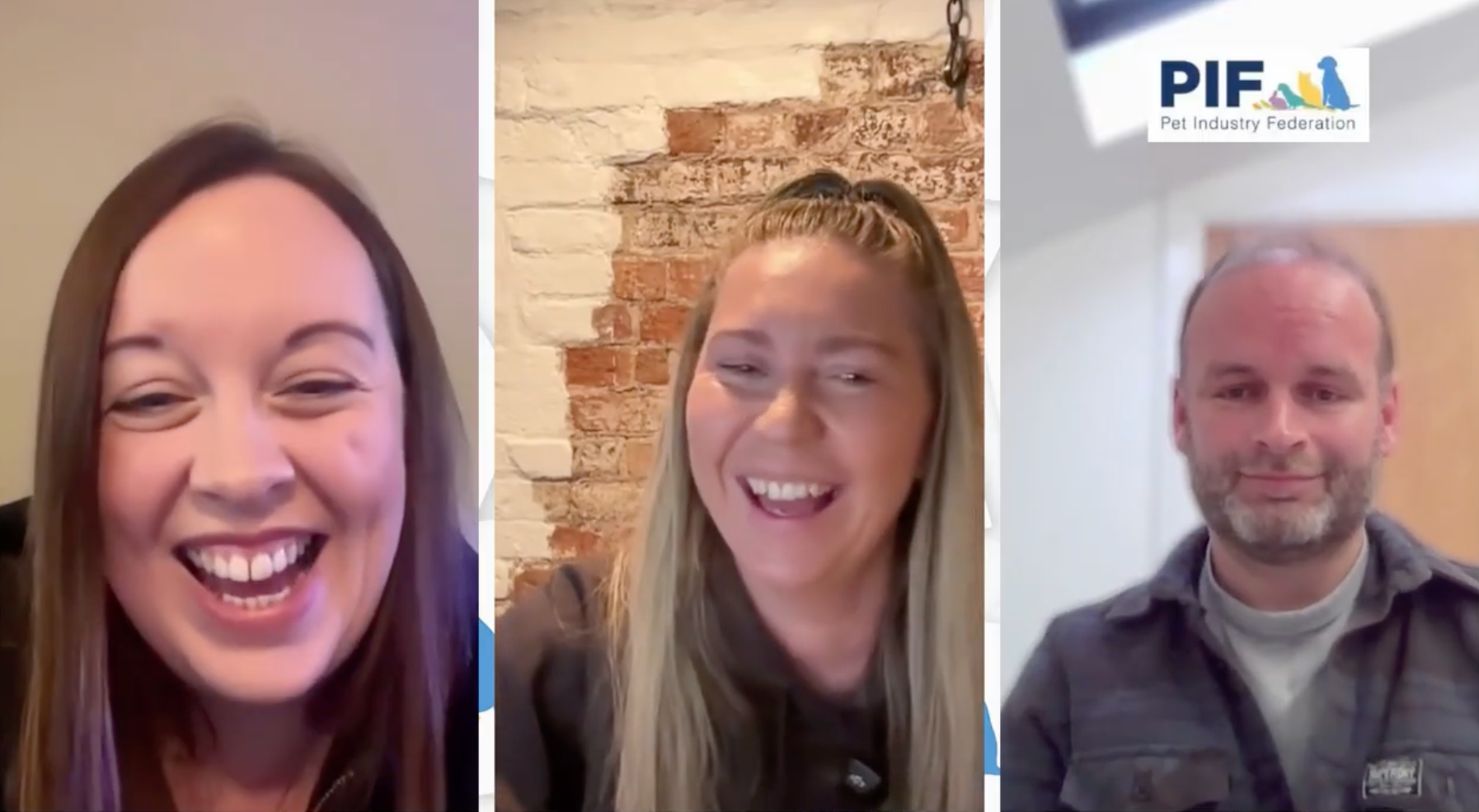
Yes. Talking-head video and live streaming are the most difficult content formats for AI to replicate, which makes them the highest-trust format available to pet businesses right now. A real person on camera showing their genuine knowledge, personality, and passion for animals cannot be faked, and consumers know it.
During the panel, the three of us landed on this point together. As I said: "The brands and smaller businesses that go live are going to win. You are authentic. People can see you, your personality, and who you are."
This is not just anecdotal. The Search Engine Land article on content marketing in the AI era, published March 2026, argues that content marketing must now be about building fame and mental availability, not just search volume. Fame is built through distinctiveness, reach, and voluntary engagement. Video, especially live video, delivers all three in ways that a blog post alone cannot (Andrew Holland, Search Engine Land, March 2026).
You do not have to be perfectly polished. In fact, that slightly unedited, real quality is part of what makes video work. People watching a dog groomer explain a technique, a hydrotherapist demonstrate an exercise, or a trainer share a real client story: that is content that AI simply cannot produce.
Practical ways to use video as a pet business:
Weekly talking-head videos answering one specific question your clients ask
Instagram or TikTok Live. Even 10 minutes of real conversation builds connection.
Behind-the-scenes clips from your working day
Long-form video (even 20 to 30 minutes) that you then repurpose into short clips, a blog post, and social captions. Exactly the system we discussed on the panel.
As I put it: "If you created a 30-minute video, you have now got 30 reels and 30 TikToks. Because you snip them down. Turn that into a blog. It is repurposing content and saying the same message in a different way."
What does the research say about where consumer trust is heading in 2026?
Research consistently shows that consumers want more human connection, not less, as AI content increases. They are moving toward smaller communities, in-person events, and brands where the founder or team is visibly present. For pet businesses, which are already built on personal relationships, this is a significant competitive advantage.
Here is what the evidence tells us:
On trust and AI: A YouGov survey of 1,287 US adults in December 2025 found that only 5% of people trust AI a lot for information and recommendations, with 41% expressing active distrust (YouGov, Most Americans Use AI But Still Don't Trust It, 2025).
On authenticity and brand trust: The 2025 Edelman Trust Barometer found that 80% of people trust the brands they use to do what is right, which is higher than trust in government, media, or NGOs. But that trust is conditional on authentic behaviour (Edelman Trust Barometer, 2025).
On community: During the panel discussion, I observed the shift already happening in our industry: "We are going to be wanting more connection with people. We are going to be looking for one-to-one events and smaller communities. Where we have had our big massive Facebook groups with thousands of people, you can see a massive shift already to smaller platforms. People want to interact with a smaller group that they can start trusting."
This mirrors what the Pet Industry Federation is seeing directly. As Dan noted during the panel, PIF's own smaller regional gatherings have been more valued by members than large-scale events, because trust is built at human scale.
What are the key takeaways for pet businesses navigating AI and authenticity?
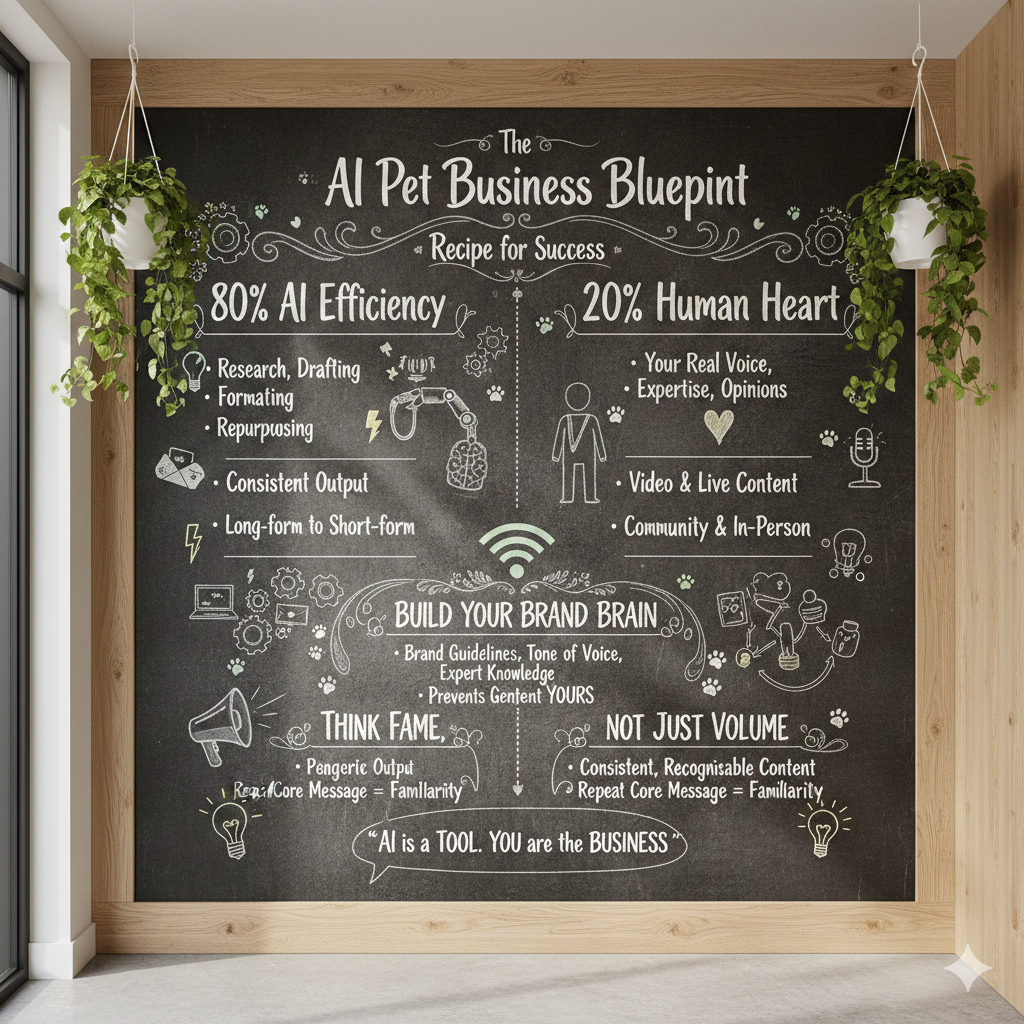
For pet business owners trying to find the right balance between AI efficiency and human connection, the core principles are straightforward:
Use AI for the 80% it is brilliant at:
Research, drafting, formatting, repurposing
Maintaining consistent output across platforms
Turning one piece of long-form content into multiple shorter formats
Own the 20% that only you can provide:
Your real voice, expertise, and opinions
Video and live content that shows the real you
Community relationships and in-person presence
Build your AI Business Brain first:
Brand guidelines, tone of voice, and expert knowledge
This prevents generic output and keeps your content unmistakably yours
Think fame, not just volume:
Consistent, recognisable content beats high volume every time
Repeating your core message in different formats is not repetition. It is building familiarity.
As I said to close the panel discussion: "AI is just another tool in your toolbox. You are still part of your business. Build your brand assets. Make sure they are consistent. And make sure that when you do put information in, it always comes back to your core business."
What the experts and research say: further reading
The conversation on authenticity and AI is happening across industries, not just the pet world. These are the sources that informed our panel discussion and this article:
Getty Images, Building Trust in the Age of AI (2024) A study of over 30,000 consumers across 25 countries. Confirms that 98% of consumers say authentic images and videos are pivotal for trust, and that almost 90% want to know whether an image was AI-generated. Full report: newsroom.gettyimages.com
Edelman Trust Barometer Special Report: Brand Trust, From We to Me (2025) Survey of 15,000 people across 15 countries. Finds that 73% of people say their trust in a brand increases if it authentically reflects today's culture, and that 80% trust the brands they use more than traditional institutions. Full report: edelman.com
Gartner Consumer Community Survey (June–July 2025) Survey of 377 US consumers. Finds that 53% distrust AI-powered search results, and 61% want the ability to turn AI summaries off entirely. Press release: gartner.com
YouGov Survey on AI Trust (December 2025) Survey of 1,287 US adults. Finds that only 5% trust AI a lot for information, with 41% expressing distrust. No industry sector achieves a net-positive trust score for AI. Full article: yougov.com
Baringa, Trust: Transparency Earns Trust (2025) Annual consumer research. Finds that 88% of consumers say it is harder now than a year ago to tell what is real online, and that misuse and misinformation are the top concerns around AI content. Full report: baringa.com
Andrew Holland, Content Marketing in an AI Era: From SEO Volume to Brand Fame, Search Engine Land (March 2026) Argues that informational SEO is collapsing as AI answers queries directly, and that brand fame, built through distinctiveness, distribution, and voluntary engagement, is the new content marketing objective. Full article: searchengineland.com
Ready to build your AI Business Brain? Start with our free guide at petbizai.co.uk or explore the tools at petbizai.app.
This article draws on a panel discussion produced by the Pet Industry Federation: "Talk About: Authenticity vs AI for Digital Marketing in the Pet Industry" featuring Kirsty Skeates (PetBizAI), Kate Hendry (Finnbo Studios), and Dan (Pet Industry Federation). Watch the full discussion on YouTube.
Explore More PetBizAI Articles
Discover more insights on AI tools, pet business strategy, legal policies, and growing a modern pet business.

Kirsty Skeates — Founder of PetBizAI
About Kirsty Skeates
Kirsty Skeates is a pet industry professional turned AI educator and the founder of PetBizAI. After building and selling a successful canine hydrotherapy centre in Beverley, Yorkshire, she now helps pet businesses: groomers, trainers, physiotherapists, hydrotherapists, and dog walkers, adopt AI tools confidently and practically.
Kirsty is a regular speaker at industry events including the Pet Industry Federation, and has been working with pet businesses on AI implementation for over two years. Her platform, petbizai.app, gives pet professionals access to Claude, ChatGPT, Gemini, and Perplexity in one place, with cross-platform memory and pet-industry-specific AI assistants.

AI fluency isn’t about perfect prompts; it’s about learning to speak naturally with technology. In this post, Kirsty Skeates explores how real progress with AI starts when you stop typing commands and start having conversations that mirror how you think, work, and create.